Home of the Sewalot Site


By Alex I Askaroff 


For antique and vintage sewing machines


Home

Machines for Sale

Valuations

Books

Our Collection

Reviews

Stories

Index

Pictures

Renovations

New Stories

Poetry

Fault Finder

Tension

Links

Sewing Machine Fault Finder                     Sewing machine Tension Problems
Elias Howe
a brief history by
Alex I Askaroff

Main Index


Alex has spent a lifetime in the sewing industry and is considered one of the foremost experts of pioneering machines and their inventors. He has written extensively for trade magazines, radio, television, books and publications world wide.


9th of July 1819-3rd Oct 1867


Elias Howe Junior patented the first ever lockstitch sewing machine in the world. His invention helped toward the mass production of sewing machines and clothing. That in turn revolutionized the sewing industry and freed women from the drudgery of some of their daily labour. From a modest beginning he became the second wealthiest man in the world from his invention!

What an opening paragraph! And open to argument. Read on and find out about our amazing young farmer who suffered from a weak constitution and was plagued by ill health that finally stole him just as he was about to enjoy his rewards.

Elias's story is a brief but turbulent one. It was one that touched the birth of the first proper sewing machine industry. Elias knew all the pioneers in his field and most of the great names in the sewing business from Isaac Singer to Grover & Baker.

Historians tell us that it was Walter Hunt, years earlier who made the first lock stitch sewing machine but he never patented it. Also we only saw his 'improved model' made after he had seen Howe's and many other machines. We cannot rely on Walter Hunt's machine but we can on Elias's Patent Model which is registered and fact. Many say that Elias Howe had somehow seen Walter Hunt's machine and basically copied it. 

There was no definitive proof of this in later court proceedings and it is unlikely, even though they do have a small resemblance. However most lockstitch machines bare a resemblance to each other as it would be hard to make one that does not! Elias was, much to his competitors disgust, given the right to his patents. Even after the best lawyers in the land had tried to prove otherwise. So we will give him the benefit of the doubt!

                     
The Howe Patent Model of 1846

Let us ignore this point and stick to the facts. His machine clearly shows the brilliant idea of a needle with a hole at the point end. This needle carried a thread, forward, through a piece of material where another thread, held in a shuttle, passed through a loop in the top thread (caused by the needle moving backward). The needle was then retracted and pulled the two threads to lock them in the fabric.

The shuttle was not new it had been used in the textile industry since the time of the Egyptians but making a miniature metal one was his stroke of genius. Along with the wrong-end eyed-needle (that's a tongue twister but I hope you know what I mean) these were his two great ideas. ideas that would later help him win the toughest court-case of the century.


Elias Howe sewing machine 1846


The ideas seems so fundamental now but way back in 1846 they were revolutionary. For centuries people had wanted a machine that would sew but not even Leonardo Da Vinci could figure it out.

Elias did what no other man had done. If you read my Sewing Machine History you will see the muddled path that led to this point in history. It is a  fascinating read. Go on read it I know you really want to.

Everyone knew the first person to make a machine would become rich. Many thousands of people worked in the sewing industry. Great factories employed girls hand sewing. Every stitch on every piece of clothing, upholstery, shoes, leather and sails was hand stitched. Look around you for a second. Even today every stitch you are wearing right down to your car seat is still sewn.

Some of the factories worked the young girls until their eyesight went. They were sent home to spend the rest of their lives with poor eyesight brought on by the constant strain of sewing 12 hours a day in poor factory conditions. It was not a good life.

Elias was born in Spencer, Massachusetts in July 1819. He was the son of a farmer who believed that his son had an inventive streak. This he encouraged. There are several different versions of how Elias came to invent such a remarkable machine.

Elias was the 4th great-grandson of John Howe who arrived in America in 1630 from Brinklow in Warwickshire. John Howe had the claim to fame to be the first white man to settle in Marlborough and helped found the town of Sudbury MA.

One of John's grandson's, David, opened the Wayside Inn in Sudbury where Wordsworth (Longfellow) spent time writing his superb poems and verses. The Wayside still exists today as the oldest Bed & Breakfast in America. How fascinating!

Now back to Elias. He worked, in-between bouts of illness, for a precision engineer in Boston called Ari Davis. Here he would repair the constant stream of faulty sewing machines that were badly designed and never really sewed well. Ari and Elias knew full well that the first inventor of a proper sewing machine would become a wealthy man.

Elias played with his ideas for years and nearly eight years later and over 40 prototypes he had made his first fully working machine. It was capable, in Elias's hands, of sewing over 250 lock-stitches a minute without breaking thread. Now all he had to do was sell it. That was not going to be so easy. After years of bad machines people were sceptical about yet another sewing machine!

Some say that plagued by his continual ill health and his long spells in bed watching his wife sewing to earn enough for the family, led to his inspiration and movement of his sewing machine. It certainly meant he had the time!

Other say that it was his early training as a machinist's apprentice at a textile mill that helped his invention. A bit of both I declare...

I have a dream

Elias himself had another version. Elias told how the idea of a needle with a hole in the 'wrong end' came to him.

It was all a dream... Elias was in the middle of a dream where Red Indians were firing arrows through cloth snagging threads and drawing the threads through with the tips of the arrows. Elias woke in the middle of his dream rushed to his workshop and put his 'dream' into practice. The rest, as they say, is history, or just a good story for the court.

Whatever the truth what we know is that he did build a machine that made a lock stitch with two threads, a shuttle and a needle with a hole at the wrong end! 

"Be it known that I, Elias Howe, Jr., of Cambridge, in the county of Middlesex and State of Massachusetts, have invented a new and useful machine for sewing seams in cloth or other articles requiring to be sewed; and I do hereby declare that the following is a full and exact description thereof. In sewing a seam with my machine two threads are employed, one of which threads is carried through the cloth by means of a curved needle..."

Now, this was not a great machine. It had lots of problems. it still fed the work vertically with the needle moving horizontally. The fabric had to be supported on pins in short lengths.

What the machine did was allow others to see his ideas and make improvements on it.This in turn led to a massive expansion in the sewing machine industry.

  
Elias's model still used a horizontal needle and pins to hold the work. 

Even after many demonstrations beating as many as five sewing girls at a time Elias's Chunky and awkward machine was not a big seller.

In fact hard as poor old Elias tried he could not sell his invention. One big problem was the price. This hand-made marvel cost over $300. In today's value that would be the price of a new car!

Elias was an unlucky salesman, he never had Singer's flare and could not sell his machine in America.


His brother told him that he had found a buyer in England on the other side of the world so Elias set sail to the distant land. It was an arduous trip and worse was to come.

In England far from finding riches he beat his head against closed doors for nearly two years. If $300 was a lot in America in England it was a years wages. No one could afford his machine.

Broke and disheartened he set sail home. It was along and dangerous journey back then, weeks at sea.

Penniless, Elias arrived home but the journey proved just too much for Elias's wife and she later died. With the sad loss of his wife he now had his children to support and no living.

Back home to his utter astonishment the sewing machine industry was flourishing. Like the computer industry a year can be a long time and Elias had been gone two years.

Isaac Singer and others had all been hard at work making sewing machines in his absence. Now, while none of these machines looked exactly like Elias's machine they had all infringed on his patents. Singer had his needle and his machine also created a two-thread lock stitch which Elias had patents for.

Elias's father re-mortgaged the family farm so that Elias could pursue his rights in court. Things were not easy. Singer had a great lawyer in Clark and the weeks turned into months then years. The whole family held their breath as the lawyers fought out a bitter and contracted battle.

This is where Walter Hunt's earlier designs proved that he had in fact invented the first ever lock stitch machine. Pity he never patented it. Elias and Isaac Singer were now bitter enemies and several times they nearly came to blows. In fact I think one time Isaac physically booted Elias out of a demonstration he was doing.

Elias wins!

In the end Elias won. Wow, what a relief! He must have jumped for joy that day. This meant that everyone using his patent had to pay him. For the first time in his turbulent life Elias was in the money.

Now let's step back and think about this. People today say Elias merely copied Walter Hunt's design. The facts are that even the best lawyers in the land could not remove his patent right. They tried every nasty trick in the book and failed and remember they were there at the time not today. They heard the testimonies saw the look on the faces of the men. Looked into the eyes of the people in the dock. Saw the sweat on the brows. 

Put yourself for a moment in Elias's shoes. He arrived back from England penniless and in ill health. His poor young wife succumbs after years of hardship and dies. Elias is left with a young family to support and no income. He finds that the only thing that he has ever done that is really worth anything is being copied and making other men rich. 

You must ask yourself, would you really go and get your father to mortgage the family farm? Would you really risk the only security you have left for yourself, your children and your parents? Would you risk all and go against what seemed to be the whole world if you did not believe one hundred percent that you were right? 

They say that history belongs to the victors and although elsewhere on my site I put the opposing argument, on this page Elias is the winner. He comes out of court triumphant.

My reasons? Firstly he had spent a couple of years working in the textile industry. He would have been very familiar with looms and the age old method of passing a bobbin through the cloth. Secondly, while ill he had spent time watching his pretty young wife hand sew knowing that if he could speed up her sewing they would make more money for the family. No benefit in those days, just poverty and starvation. Thirdly he was the son of a farmer and if I have learnt one thing on my travels, farmers can make just about anything. They are the most pioneering self-sufficient breed on God's earth.

Put all these ingredients together and you have the perfect mix for the necessity of invention. This is why I believe Elias was the real inventor of the lock-stitch sewing machine.

The dream comes true

Anyway he was victorious in court and although his enemies spent endless hours trying to tarnish his reputation it was all in vain.

In 1854 some eight years after his original patent He was rolling in cash. Isaac Singer had to fork out over fifteen thousand dollars as did several other infringers. This was more money than Elias could ever have dreamed of and there was more to come. He paid off all his debts and father's mortgage on his farm. 1854 was possibly the best year of Elias's life.

Every sewing machine made in America that used Howe's patents had to pay him royalties, five dollars for every machine sold in the USA and another dollar for everyone sold abroad. Elias had hit the big time. In a few years millions rolled in.

In 1854, Amasa, Elias's brother set up a sewing machine factory to start producing sewing machines. A dream had come true. One of the funny things with inventors is that they often spend more time in court than on their inventions. This was true of the Wright brothers and Joseph Diesel of the diesel engine. They both spent more time in court than in the workshop.

The following year, in 1856, the Sewing Machine Cartel was formed and the big boys, who held most of the patents covering this new fangled machine, sued and charged everyone for using their patents. Of course the Sewing Machine Cartel was really little more than an illegal monopoly and  the law was eventually changed to dismantle it. That took 20 years! 

By then it was all too late. Elias Howe had risen to one of the richest men in the world. He hired writers to re-write his version of events and tried to make sure history remembered him as the man who truly invented the sewing machine. It did not work.

In 1860 Elias managed to extend or renew his patent rights for another seven years. There was talk of greasing the wheels to get this extension and he must have known the right people in the right places as there was little or no justification for the extension. However from then on he only received $1 for every sewing machine made by any manufacturer in the US.

When the American Civil War raged he used some of his enormous wealth to equip the whole 17th cavalry regiment of Connecticut volunteers, then enlisted himself, as a private and regimental postman. This showed the modesty of the man that many fault today. This fact needs confirming for such a weak man to serve as a private is amazing. The hardships alone would kill a strong able bodied man. Then again he may have been in his prime and willing to fight in what he believed. I would never blame a man for that, nor should any.

As the Civil War ended there were many scars to heal after the war and some men raged on, like the James brothers, Jesse and Frank who joined with the Younger's to form the James-Younger Gang.

In 1866 in Liberty, Missouri the gang  made off with over $60,000 from the first American bank robbery. It was to be the start of many.

In the same year Elias was awarded a gold medal at the Paris Exhibtion and decorated by Napoleon III with the Cross or Legion of Honor for his contribution to fellow man.

By 1867 Elias had been awarded over $2,000,000 in patent and licence fees. Elias had also amassed a fortune of over $10,000,000. He had become one of the richest men of his day!

Unfortunately, the one thing that all Elias's money could not buy was good health. In October of 1867, two years after the bloody war ended, in Brooklyn, New York, poor old Elias bit the dust. He died at his son-in-law's home.He was only 48. Strangely enough it was the same year as his patents finally ran out.


9th of July 1819-3rd Oct 1867
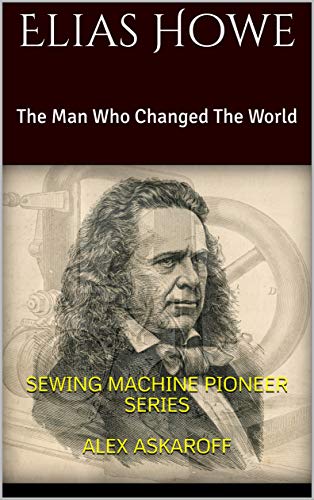
Elias looked frail in this portrait and years older than his actual age of 48.

And so the legend dies. I believe that he left A second wife, Rose Halladay, and six children,the youngest a girl was named, Mertie.

Elias & Rose are buried together at Greenwood Cemetery in New York.

In his short life he had been part of the inventive genius that would change the world forever. He had fought with giants and won.

Whatever people tell you Elias Howe will go down in history as the first man to patent a lock stitch sewing machine..., well done mate.

The strangest twist to this tale is that most youngsters today will have only heard of Elias Howe because of the Beatles!

At the end of the Beatles film Help there is a little dedication...To Elias Howe, inventor of the sewing machine! How weird.

The End... Almost


The Howe sewing machines

There were actually two factories making Howe machines and both run by relatives keen to capitalise on Howe's inventions.

There was the Stockwell brothers factory. They were Elias's brother-in-laws. They opened a factory at Bridgeport Connecticut. The factory was actually opened by Elias in 1865 just at the end of the war. He had little to do with the factory but allowed his image to be put on each machine. These machines were marked as original Howe machines and closed around 1885-6.

The other factory was owned by Elias's older brother Amasa (who he had gone to England with) and Elias's nephew. That was in New York and had opened  around ten years earlier in 1853-4. They made super machines that won many medals and great respect.

The Stockwell brothers factory was initially set up and supposed to help with the demand that Amasa could not handle. At first the two companies joined (in 1865) but Amasa split away from the Stockwell brothers as they were having quality problems and that reflected on his sales. He was being tarred with the same brush and sales were falling.

It was an acrimonious split and litigation followed over the marking of both the factories machines. Elias was stuck in the middle of feuding relations but his untimely death brought no conclusion.

All machines from this factory were marked A. B. Howe. The factory closed in 1870 after Amasa's son sold the factory to the Stockwell Brothers who shut it down. The Stockwell brothers factory also closed 15 years later. And so the Howe name moves out of the sewing machine business.

Above is the last Howe model.

Many machines were marked such as...Howe Model-B manufactured in New York and sold by the Howe Sewing Machine Co. No. 4 Sixth Street Pittsburgh, PA.

It is said that as many as a million Howe machines were produced. the rarest being the hand models as most were treadle machines. All serious collectors should have a Howe machine or two in their collections.

A brief history of Elias Howe
By 
Alex I Askaroff

Well I do hope you like this little chapter in sewing machine history. I have spent endless hours researching and writing it for your interest.  I love to know what you think, also if you spot any mistakes do mail me: alexsussex@aol.com

Now, if you have a second spare for a good read click below. It is the true story about a young girl growing up during the Second World War in England:

 Spies & Spitfires


Alex's stories are now available to keep. Click on the picture for more information.


 Home    Index     Books


 Skylark Country