Home of the Sewalot Site


For antique and vintage sewing machines


Index

Home

Fault Finder

Machines for Sale

Valuations

Books

Our Collection

Reviews

Stories

Pictures

Links


Renovations

New Stories

Poetry

Crows Nest Publications


A  BRIEF HISTORY OF COTTON

By

Alex Askaroff 


  Alex I Askaroff

Alex has spent a lifetime in the sewing industry and is considered one of the foremost experts of pioneering machines and their inventors. He has written extensively for trade magazines, radio, television, books and publications world wide.


Have you ever asked yourself how old is cotton? 


Well let me tell you. Scientists in Mexico found pieces of cotton cloth that were at least 7,000 years old. They also found that the cotton was very similar to that grown today.


Wild Cotton Bud


In Pakistan, cotton was being woven into cloth  around 5,000 years ago. Cleopatra wore the finest cotton grown in the Egyptian’s Nile valley, not while soaking in asses milk though!


The first spinning wheel was thought to have originated in India about 500 years before Jesus was born. from that point on cloth was available to all and reels of thread in various forms followed.

Arab merchants brought cotton to Europe about 800 A.D and when Columbus bumped into a big lump of land and called it America in 1492, he found cotton already growing.


Cotton seeds are believed to have been planted in Florida around 1556 and in Virginia in 1607. 


By 1616, colonists were growing cotton along the James River in Virginia.


By the 1450's, cotton was known throughout the world.

Cotton was first spun by machinery in England in 1730. You can see more on my Coats and Clarke history at the end of the page. Sewing machine threads. 


Much was made of the American Civil war and the part the precious resource of cotton played in it. History of sewing threads.


A Massachusetts man, Eli Whitney, secured a patent on the cotton gin in 1793. Though patent  records show that the first cotton gin could have been built by Noah Homes two years before Whitney’s patent was filed. 


The cotton gin, where we get the abbreviation of en-gine, could work 10 times faster than hand.

The mechanised gin, not the liquid stuff boys! Made it possible to supply large quantities of cotton fibre to the expanding the textile industry.
That in turn made it possible to obtain cheaper clothing


Today cotton is still one of the finest, natural and most durable of materials, even though it does crease like crazy.


Well that's all folks, I did say a brief history...


For more information about British thread history click on the Coats badge or click on the links below.


Fancy a funny read: Ena Wilf  & The One-Armed Machinist

A brilliant slice of 1940's life: Spies & Spitfires


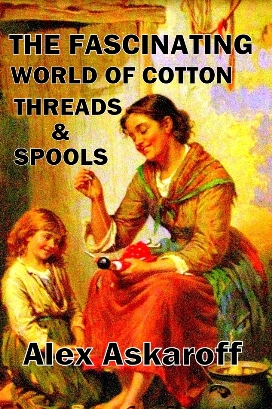
Alex's stories are now available to keep. Click on the picture for more information.


Some useful links for your research:

Handspun Sewing Threads

History Channel

Jacobs burg historical Society

Mountain Man Cyber Rondezvous

Newtown Battlefield,N.Y

Society of 18th-Century Gentlemen

Archiving Early America

Blomers4u

British Brigade

Australian Textile Arts & S D
Fashion Fantasia
Australian Silk Worm
Paperclay
All About Hand Dying Fabric
World of Embroidery
Embroiderers Guild 2002 Exhibition


TextileArts.net - Resources
The Worldwide Art Gallery
Sian Martin, Creative Studies
Practical Study Group
Innovative Threads
The Webstitcher's Sourcebook
National Gallery of Australia
Hundertwasser Art Prints
More Hundertwasser
Computer Textile Design Group
Australian Fibre and Textile
Textile Art Collections
Victoria and Albert Museum
Guggenheim Museums
The Museum for Textiles
The Louvre Museum
Nita Leland - Artist
The Costume Page
Craft Australia
The Museum of Costume in Bath
Needlework Stitch Dictionary
Textile Exhibitions
New Zealand Wearable Art
Janet Davies, Embroidery Author
Cathy Daulman - Artist
Wearables


This website is Copyright © 2001 & 2008 SSM

CONTACT: alexsussex@aol.com