Home of the Sewalot Site


By Alex I Askaroff 


For antique and vintage sewing machines


 Skylark Country

Index


Index

Home

Fault Finder

Machines for Sale

Valuations

Books

Our Collection

Reviews

Stories

Pictures

Links


Renovations

New Stories

Poetry

Crows Nest Publications


Sewing Machine Fault Finder                     Sewing Machine Tension Problems

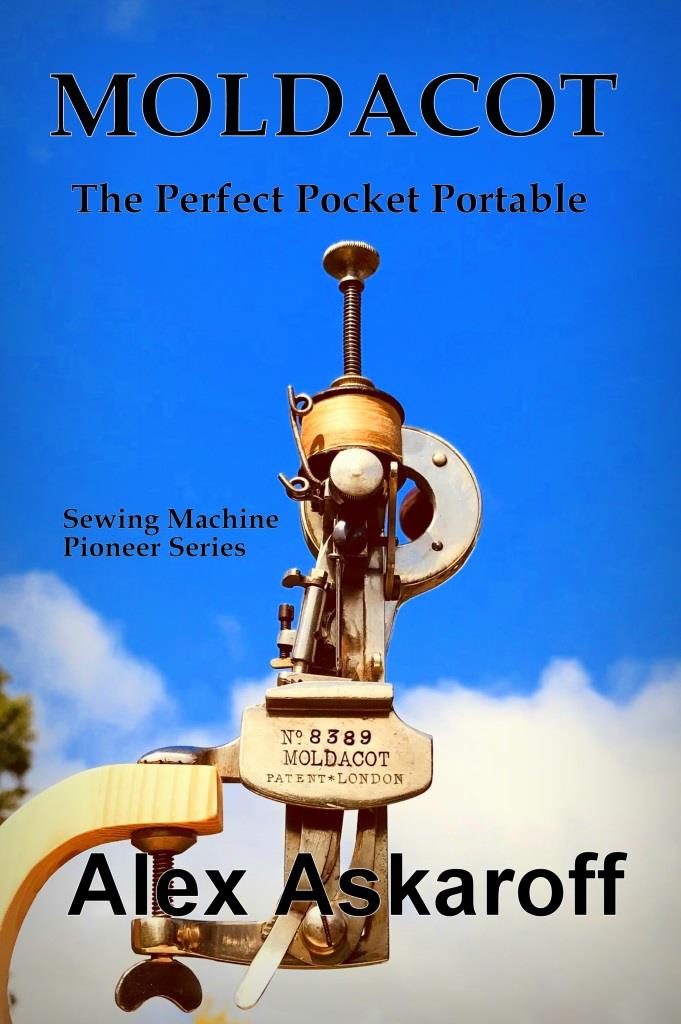
Moldacot

The Perfect Pocket Portable


          Alex I Askaroff

Alex has spent a lifetime in the sewing industry and is considered one of the foremost experts of pioneering machines and their inventors. He has written extensively for trade magazines, radio, television, books and publications world wide.

The Moldacot Sewing Machine

The Most Useful Invention of the Century
or
The Perfect Pocket Portable

MAGNIFICENT MOLDACOTS


Moldacot lock-stitch rotary sewing machine of 1885

Moldacots are my all-time favourite antique sewing machines and I have the largest collection of them in the world.

The Moldacot sewing machine is one of the most sought after and widely collected Victorian sewing machines of all time. There are just about enough of them floating around in collections, boxes and drawers to satisfy most collectors.

The Moldacot appeals to sewing machine collectors but also collectors of Victoriana and engineering enthusiasts. It is a fascinating small piece of engineering that took the Victorian era by storm.

So where do we start with this superb mechanical marvel that was patented in December 1885.

The Moldacot burst onto our markets on July 17th 1886. Prices seemed to vary from as high as 50 shillings to as low as three shillings and sixpence and the final sell off.

The Moldacot sewing machine took the sewing machine market by storm. Described by the Financial News in glowing terms "As the most useful invention of the century."

Other sewing machine manufacturers must have been seriously worried that all of a sudden here was a cheap small easy machine that could be carried with ease bolted to any surface and sewn with. The chunky machine oozed quality unlike the tin-plate toys. Also it was a lock-stitch.


From every angle the Moldacot is a masterpiece of unique Victorian engineering

Within weeks the share issue was vastly over subscribed and £100,000 poured in from investors hoping to make a killing with this little gem. £100,000 was a vast sum in the Victorian era, when the average weekly wage was a few shillings.

The advert read "The Moldacot is a perfect lockstitch sewing machine that will take any kind of material from the finest linen to the stoutest cloth."


Moldacot Sewing Machine Tins came in several different colours.

Wow, was that an exaggeration! One of the reasons why this ingenious machine fooled so many people was the fact that it was a superbly engineered piece. No stamped out piece of tin-plate this baby. And the idea was great, a sewing machine that you could put in your pocket, wonderful.

" At last a machine well within the reach of the classes" the papers of the day stated. The reality was much further from the truth along with hair-loss treatment and snake oil the Moldacot was a well engineered but a scam. Whether it set out as a scam we shall probably never know.

Now don't get me wrong they are fantastic machines I have the largest collection of them in the world but they just do not sew well at all. In fact 99% could hardly make a stitch except in trained and skilful hands. Read on...

The latest marvel
To be exported all over the world
As recommended by the London Times
So wonderfully simple a child could use it!

Oh if only it were true...

We are surrounded with questions about the Moldacots. In the centre of our web are the almost invisible inventors A.D.Moll (Albert) and J.C.Cottam. From their names on every machine, we may guess that they were the beneficiaries of the sales of the Moldacot sewing machine.

What was their connection with S.Rosenthal, the main inventor possibly from Berlin?

I can't wait for the Internet to develop further so that I can track these people down.

Recent developments at the Smithsonian have shown S. Rosenthal may have been Sally Rosenthal. She was connected to a later Moldacot patent application and another toy machine called La Queen. La Queen sewing machines, similar to the Tabitha sewing machine are very rare.


La Queen Sewing Machine courtesy of Don Shepherd


Although little else has turned up to date. Also the names of, C.J.Croft, F.Dowling, JJ.Robinson, and J.Holroyd. Wm.Bown and F.S.Sharpe are all connected with other various Moldacot patent applications.

This makes things as clear as London pea soup.

Yet another patent application appears by Moll and Cottam in July 1886 when they applied for improvements to the Moldacot, mainly for hand wheels that were later attached to the machines. However, they were certainly not on the board of directors and no trace of them turned up in the liquidation hearings. They seem to fade away into history. Did they all run off together and live happily ever after in a suburban semi-near Chelsea ?

The South Australian Advertiser August 1886
 Elected chairman of the recently floated
Moldacot Pocket Sewing Machine Company,
 Mr. Howard Spensley hopes that he will
presently be reaching the colony of Victoria, Australia, to dispose of the reserved shares in the successful company.


The Moldacot bobbin and case are the smallest in the world!


Was the Moldacot bobbin and case from the American Mitchell Patent of 1859, 26511?


The brilliant design detail is what made the Moldacot stand out. The Moldacot had adjustable stitch length and tension.

The Moldacot offices were temporarily based at Bloomfield House London Wall and 58 Coleman Street London. The chairman Mr Arnold Pye Smith looked as if he just sat by with the company secretary, Mr W.Irving whilst the company fell apart around them.

To begin with they blamed the inability to manufacture the machines as the cause of their demise but we later find that thousands may have been produced.

It is a big may, considering how few have turned up and how creative accounting is prone to exaggerate in companies that have been purposely formed to raise investment. Also taking into account the early floatation of the company it is a very optimistic claim.


Most Moldacots had the London patent and stamped Made in Germany if they were German and left plain if British.

The possibility that 60,000 Moldacots were produced is highly unlikely but possible. They are not the sort of thing that people throw away, they don't take up space, they have no scrap value and they look interesting and feel valuable. I would make a guess that less than a fifth of the exaggerated total were actually produced out of which less than 1,000 may survive today.

By now the company was also advertising itself as the

 Moldacot Colonial & Foreign Pocket Sewing Machine Company, Ltd.


One of the earliest Moldacots to surface so far, serial No 348 in a leather deluxe box. This is the only known example of the London Patent machine that I have seen-pre hand-wheel with such a low serial number, now in my collection.

There were at least three main manufacturers, two in Britain and one in Germany, although the German Company has yet to come to light. If you know of the German manufacture please mail me I would love to find out: alexsussex@aol.com

The British companies were J.Holroyd of Tomlinson Street Manchester, and W.M.Bown of Brearley Street Birmingham. Surprisingly all these models have the London stamp on them. However I am not ruling out a London manufacturer turning up! Almost any skilled small manufacturing or jobbing engineering firm could make the Moldacot. 

The machines sold through a few retailers that did not normally stock sewing machines like Stewart & Co of 249 Oxford Street, London. They also sold watches, jewellery and fancy goods.

Every Moldacot sent out thoroughly cleaned, oiled and in perfect working order


The Moldacot Company had loads of happy customers. I have pages of testimonials. Were they made up?

Sale of the Century

Within two years the company had shot to the stars and collapsed into the fiery pits of liquidation, manufacturing only a fraction of the millions of machines that the chairman had originally promised. There was no need for Singer's to panic anymore.

Over £50,000, the equivalent of well over a million today, of shareholders money disappeared in such things as manufacturing costs and patent rights.

Was this possibly a nice retirement for our two inventors, Moll and Cottam? At a cost of 8 shillings to manufacture (an unacceptably high amount seeing, as they were only selling for 10s 6d and only later at 16s or $1.25) that would have accounted for many thousands of the `lost` shareholders cash. Eventually they were being cleared out for a third of the price.

No matter what was going on in the book-cooking department by 1888 the then called United Sewing Machine Company collapsed. One point of interest is that Albert Moll lost his first wife and if it was during this period it could explain a lot.

The Surplus machines were auctioned off to try and pay some of the debts.

1888

1888 was the year that the notorious Jack the Ripper stalked the streets of London. Amazing to think that he would have walked near the Moldacot business. The newest Fleet Street daily, The Star newspaper was the first daily tabloid to dramatise the murderous exploits of who they originally called the Murder Maniac. It was only after the savage murder of Mary Anne Nicholes that the Name Jack the Ripper was born. It would be a name that would live on in infamy across the decades.

Thomas O'Connor, editor of The Star, was not interested in sewing machines, he was interested in mass media sales. The murderous wave of death by a crazed lunatic was just what he needed. All the daily papers would have been full of the frenzied attacks on Whitechapel prostitutes. And so little notice would have been paid to the demise of the humble Moldacot.


Rumours

A few machines were sold to a South American/Spanish/Portuguese firm and renamed Bonita, (beautiful) probably as a novelty more than anything.

These are amongst the most sought after models and as rare as hens teeth. I doubt if they were sold as working machines. All the Bonita models have thinner name plates as if the old names were simply ground off and then re-stamped Bonita and re-plated.

Also, all the Bonita machines were from Germany. Was the German plant getting some of its money back by selling bankrupt stock?

Years later some more machines were discovered in a disused London warehouse which led to the most amazing story of all.


The Titanic

The strangest story of all, quite unlikely but definitely my favourite, is that a stock of Moldacots found stored in a building about to be demolished several decades later in 1911, were sold to an American entrepreneur. He then shipped them, a year later, to the States aboard the ill-fated Titanic only to disappear in a watery grave.


The smallest working lockstitch bobbin and case in the world. The picture is double size!

The New York based paper the Sewing World noted; "The machine will not be remembered as the magnificent, but more likely as the notorious Moldacot".

The London Times chipped in renaming it "The Mouldy Cat".

The advertising for the Moldacot was a laugh...

The Moldacot will accomplish all kinds of work from Muslin to sacking.


The final 1,000 Moldacots were sold off by the specialists J Theobald & Co of London

The real reason for Moldacots demise was very simple, the machine did not sew well, it was temperamental and full of design flaws. This is lucky for collectors as it means that many Moldacots survive with very little wear and tear.

The Moldacot was rushed onto a waiting market before it was perfected. All the advertising and huge fanfare was as the old saying goes... the pride before the fall.

Perhaps the pressure from the shareholders was so intense they rushed forward with manufacture and distribution. I remember researching Elias Howe and how he struggled for years trying to get his sewing machine to stitch spending precious months building each machine while others like Isaac Singer overtook him and stole his market.


Note the improved hand wheel on this model.

While the Moldacot company was collapsing agents were still being acquired from London to Wellington in New Zealand. Today with computers and mobile phones the company would have wound up its staff around the world in a matter of minutes. I can guess that some agents were half way around the world by the time they heard the news that their company had collapsed.

Moldacot stockists
Whitelock & Son, Draper's
Castle Bay, Somerset
.

The flaws that stopped the Moldacots from sewing well were passed on from manufacturer to manufacturer. Because several factories were producing the Moldacot they would have simply have done as instructed and made the machine to exact specifications. They would not have improved or modified the machine simply filled the orders.


Theobald's advertised in many local papers, publications and magazines around the country to sell off the final Moldacots

And so our poor Victorian beauty, the perfect pocket portable, bites the dust for one simple reason it won't sew well.

"I remember my father trying to get it to work, I watched with fascination as he attached it to the kitchen table . He played with the Moldacot trying to get it to sew. It was not long before he started his cursing!"

On studying the mechanism a few simple improvements would work wonders, a take up spring to remove slack thread from the shuttle area, an adjustable shaft to allow individual timing for each machine, a stronger action on the foot to allow the work to feed better, bobbin case tension springs and so on. It is easy for a sewing machine engineer today to say this with a 120years of sewing machine mechanisms to fall back on.

The Moldacot may be seen and tested at
F. J. W. Fear's
Willis Street,
Wellington
New Zealand

But the fact remains that Albert Moll, Cottam and Rosenthal seemed to stop at the final hurdle and never got there beautiful Bonita sewing machine quite right. Were they so pleased with the influx of money they became side tracked? Did they believe it was finished? I doubt it; after all, if the machine were easily operated, there would have been public exhibitions and displays; the public seemed more than willing to invest in the company.


You can see that the price of the Moldacots falling, here to 16 shillings down from 50 at its peak and was now being sold through a jewellers rather than a sewing machine shop. The price was falling and falling fast.

Problems

Any one who tries to operate a Moldacot soon discovers the pitfalls; only with careful manipulation can you give the impression of successful sewing. I know there is the odd one that does sew but not the majority. This has never put collectors off in fact it means many Moldacots survive in excellent almost unused condition.


The Moldacot sewing machines came with a host of instructions. They were even printed on the tin.

Funnily this makes no odds to collectors who treasure them for their rarity, quality and workmanship. The fact that they have not been sewed with means many survive in great condition unlike many other sewing machines.

At the company headquarters there were specially trained girls that knew just how to sew with the machine and could give a good impression of the machine sewing. However, they would not allow anyone else to have a go.

Were Moll and Cottam removed by greedy businessmen who only realised too late they were still needed? The truth is that we will probably never know.

The machine is driven by a winch handle. The needle-bar reciprocates and its upward motion is assisted by a spring. The presser foot is rocked by a projection on the needle bar at each extremity of the stroke, so providing feed motion which is toward the operator. To have the feed in this direction is a matter of convenience in a small machine

What we do know is Moldacots turn up in an amazing variety of different boxes, green, red, blue, cardboard and my favourite, leather. On the side of the metal tins were adverts for Horrockse's finest cotton.

Needles were produced by Henry Milward & Son and A Booker & Co both from Redditch. The machine used a No1 tapered needle.

There is a brilliant needle Museum in Redditch and well worth a visit if you are in the area. Charles Dickens once visited and was impressed to see boys no younger than six working there!

The famous East End London matchmakers Bryant & May also made the cardboard boxes with the metal strips on each corner. Bryant & May still produce matches to this day under far stricter regulations.

Back in Victorian London factories employed children. The sulphur and chemicals gave rise to many illnesses. This was the London of Charles Dickens and Jack the Ripper where a poor child's life was only measured in their working ability. Dr Bernardo was so stunned on passing through London that he stayed and helped the poor orphans rather than go on with his journey.


Bryant & May made some of the rarest Moldacot cardboard boxes this isn't one of them it was plain!

Back to the Moldacots.

The machines themselves differ quite considerably, plungers, hand wheels, closed and open (open being the more popular amongst collectors), many different stampings on the plates and other parts, crowns anchors, moons and crosses.


A rare leather Moldacot sewing machine box now in my collection

The rarest of the Moldacots did not have a hand wheel at all. Although you have to be careful that someone has not just removed the hand assembly. You will note there are no mounting holes on the side of a genuine non-hand-wheel Moldacot, also a single thread guide wire hole and no quick release for the bobbin case. This is easy for an expert to see.

Hand Wheels

After the first year of manufacturing all Moldacots, both German and British, had the holes in the side regardless of being supplied with a hand wheel or not.

The hand-wheels, in open or closed form, were an optional extra priced at 2/- and 3/-(shillings). The machine can operate without the optional extra but it was a nice little earner for the company to sell the different hand wheels after the original purchase.

Some Moldacots survive complete without the hand-wheel, some early models not even having the mounting holes for the extra assembly. These are the rarest and most collectible of all the Moldacots.

You will note, if you have an early Moldacot, in its original tin, the instructions on the tin make no mention of the additional hand-wheel, just the plunger operation.

Also it is almost impossible to cram a Moldacot with a hand wheel into the tin. It makes me wonder if the tins were made in one go by another factory at an earlier date by one manufacturer and the machines subsequently fitted into them.

Bobbins

From serial No 1 to 11,000 the bobbin case was pushed out of the sewing machine with a pointed object. Tricky and frustrating as I always drop the bobbin and case. After 11,000 production modifications and the 1886 Isaac Patent allowed the bobbin case to be removed with an extra hinged locking bar which was far easier. It saves me bending over to pick up the bobbin and case as well!

One other technical point to note is that the British Moldacots had an extra hole in the side to push in the bobbin winder stem which acted to set the needle to the correct height. The German ones did not have this very useful feature. I wonder why?


This fascinating piece of paper tells a real story. Notice the discount from 50 to 16 shillings to 3/6! A massive discount to clear stock ASAP!

All the different markings on the machines may lend some credence to the chairman’s report stating the original difficulties they had in securing reliable manufacturers. Were they hoping that the manufactures would sort out the fine-tuning? Whatever the truth there is no doubt a lot more will come to light about the machine.

In effect, what do we have? One of the most sought-after small sewing machines of all time, made for just a few years and collected by toy and full sized sewing machine enthusiasts. The Moldacot is also treasured by other collectors as well for its superb quality and unique design. It is always a great talking point in any collection.

Priest & Holdgate
Sole Agents for
Moldacot sewing machines
South Canterbury

With a little more effort the Moldacot could have become a fine sewing machine carried by seamstresses and tailors in their pockets all over the world. Instead, the Moldacot disappeared for over a century to reappear as a unique collectors item.

The last we hear of the Moldacot was down in Australia as late as 1889. An advert appeared in The Argus looking for agents to handle the shortly arriving Moldacot Pocket Sewing Machine. Needles to say they never did.

Scam or no scam in 1886 the Moldacot was greeted by an excited Victorian public as
 the perfect pocket portable.

Values

Made so long ago and now so rare, Moldacots come up now and again. All depends on condition. For example one missing a part is practically useless as you will probably not find a spare part for a machine made around 1886.

All serious collectors have a Moldacot or two in their collection some like me have many. They reflect an historic time in our history. 

Perfect and complete Moldacots have fetched great prices with the best fetching over $1,300 in 2009 so if you see one going cheap grab it while you can they will only get scarcer, rarer and more valuable as time goes by. Make sure it is complete it is almost impossible obtain any spare parts. In March 2012 a Moldacot was sold for $1600 complete with blue tin but that seems amazingly high to me.

The most valuable Moldacot you'll ever find will be in a leather case, Stamped Patent, London, very low serial number and no hand wheel. plunger only, no mounting holes for one and no release catch for the bobbin case. I have only come across two in 30 years of searching.

Well that's it folks, just about everything I have ever learnt about this wonderful little marvel. If you have anything to add I would love to hear form you. alexsussex@aol.com

Elvis has left the building!

For Sale

I currently have this original beauty for sale. It is one of my finest Moldacots in simply stunning condition. Click on picture to see all the extras with it or mail me for details: alexsussex@aol.com

I do hope you enjoyed the Moldacot history, It has taken many years to compile. Do drop me a line if you have anything to add: alexsussex@aol.com

 Alex I Askaroff


News Flash!

All Alex's books are on www.crowsbooks.com

Both Sussex Born and Bred, and Corner of the Kingdom
 are now available instantly on Kindle and iPad.


Home Time for a great story: Spies & Spitfires


Alex's stories are now available to keep. Click on the picture for more information.

  Home            Index                Books

Dear Alex

I have just read your very interesting article on the Moldacots.  I 
have one used by my great uncle during the First World War.  It is a 
Moldacot Patent London with an anchor104669.
I have wondered about it for years and thought it 
about time I found out more about it.

Many thanks for your article

Stella Lodge
 

G'day Alex,

Just came across your article on the history of the Moldacot sewing machine while researching the one that I have, very interesting and informative.

I am rather glad to hear that they never worked properly as I am a fitter and turner with 30 years experience and while I can appreciate the mechanism and what it is trying to achieve, I have never been able to get it to actually sew without getting a tangled mess of thread.

The machine was my Grandmothers and I have been fascinated by it for at least the last 40 years.

Regards

Chris Blake
Tasmania, Aus
 

Hi Alex
 
Your site has the most info I have ever seen!!!  Thank you for making a site regarding the Moldacot as I have never seen one before! My Great Grandfather's name was Albert Moll.

Albert Moll had two sons and a daughter from his first marriage in London. After his first wife passed away, he remarried.

His son, my Grandfather, was John Samuel Watson Moll who emigrated to Canada. I recently located my Grandfather's grave in North Vancouver and found there was not even a grave stone to mark his burial plot (or his brother's).  I had two grave stones made up and placed.  I am interested in finding out more about my English heritage and the Moldacot Company
Kind regards....
 
Chris Sihota
c.sihota@hotmail.com 


CONTACT: alexsussex@aol.com


 Skylark Country