Home of the Sewalot Site


By Alex I Askaroff


For antique and vintage sewing machines


Home

Machines for Sale

Valuations

Books

Our Collection

Reviews

Stories

Index

Pictures

Renovations

New Stories

Poetry

Fault Finder

Tension

Links

Sewing Machine Fault Finder                     Sewing machine Tension Problems

Singer 201 Singer 201k

  Main Index                           Skylark Country


                Alex I Askaroff

Alex has spent a lifetime in the sewing industry and is considered one of the foremost experts of pioneering machines and their inventors. He has written extensively for trade magazines, radio, television, books and publications world wide.


The first Singer 201k cast iron heavy and superb.

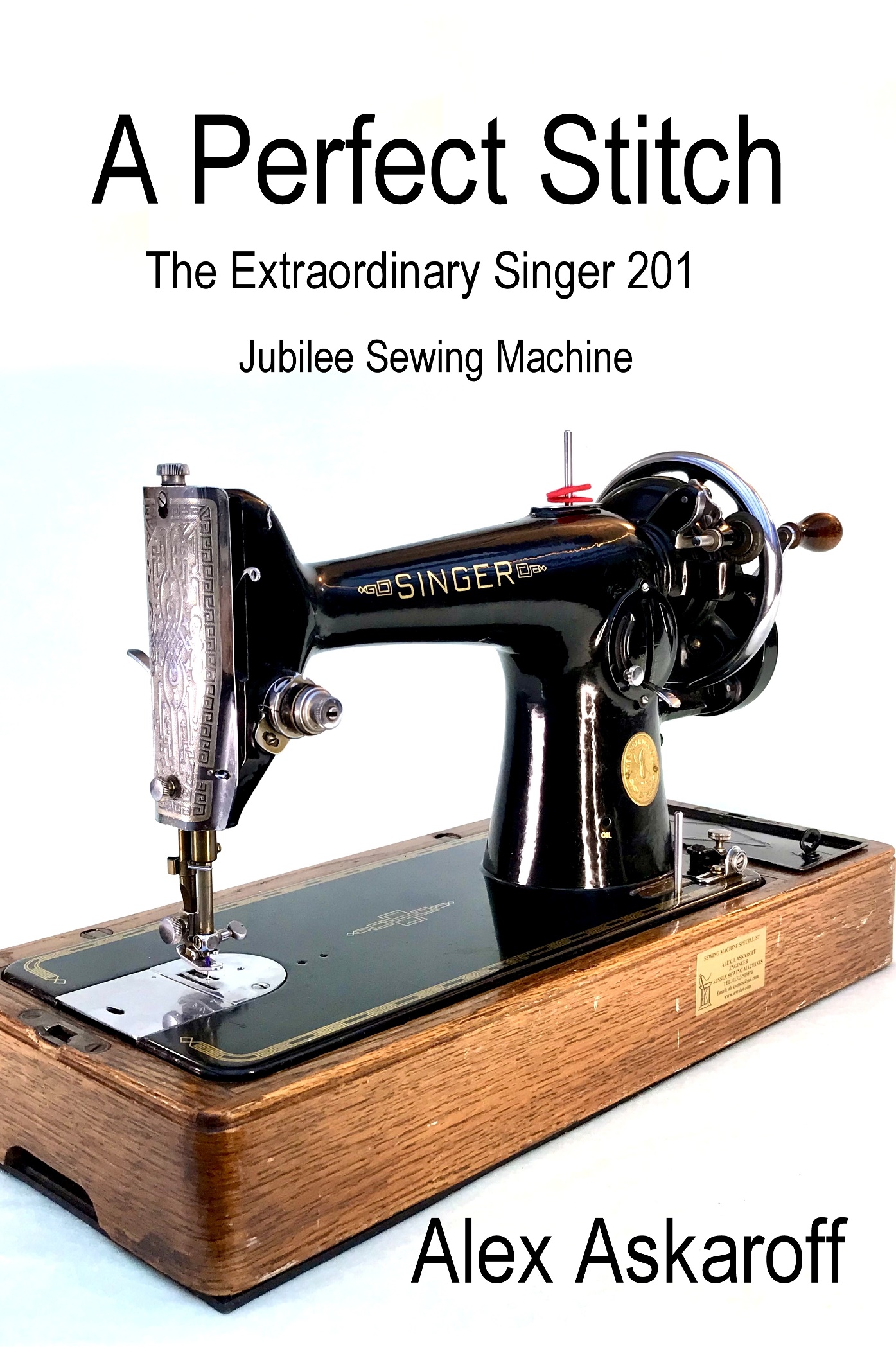
The Singer model 201K first hit the streets just before World War II and boy what a machine it was. The full rotary hook and high-carbon super-hard meshing gears gave the machine a smoothness that other sewing machine manufacturers could only dream about. But all this came at a cost. It became Singers most expensive sewing machine at the time.

The Singer 201K was bought mainly by professional machinists who would sew for a living. The Singer 201K was pretty much bullet proof and could take a direct hit from a nuclear missile and still sew. Today there is no sewing machine made that will stitch better than the Singer 201sewing machine.

Singer 201k during WWII


The Singer 201k during the war. Picture courtesy of Mrs Milligan, one of my customers.


Singer's 201k was undoubtedly the pinnacle of Singer's quality machines. The 201 had arrived on the scene after nearly a century of evolution. It had the very best features of all Singer's models and a price-tag to match.

The Singer 201K has gone down in history as Singer's finest model. Although technology has moved on, quality has not. The Singer 201K simply represents the very best that Singer's could make and was built to last a lifetime. Even today many professional sewers seek out this elusive model as no new machine can come close to this beauty for reliability and stitch quality.

Legend has it that Rolls Royce used the Singer 201to sew its premium hide to panels for some of their finer car upholstery as the Singer 201 made a small neat hole compared to the larger machines. I doubt if it is true but you can see how a machine of this quality can start rumours like this. I certainly know of a bookbinders that switched to the Singer 201 from industrials at their factory. I used to service the machines and remember clearly the rows of Singer 201's sewing away quietly compared to the normal factory din.

All the early Singers were cast iron but in the 1950's Singer switched to Aluminium to save a bit of weight. The Singer 201K still weighed a ton and were known in the trade as Back-Breakers!

I remember a  story about a woman walking into a shop in post war Britain. "I would like a Singer." The Singer man just shrugged and said "Wouldn't we all madam, wouldn't we all." In reality times were so hard and material so scarce that they would be put on a waiting list and be notified when one was ready. Some people would wait months for a new machine. A little bit different to today eh! 

Now when I say expensive let me explain...


Singer 201k receipt 1940
 

You can see from the receipt that Mrs Jeffrey paid 13 pounds 17 shillings and tuppence for her brand new Singer 201 in 1940. Her weekly wage at that time was 10 shillings. The average wage was little over one pound. She had paid the equivalent of 27 weeks wages for her Singer 201K! Now in today's money what would that be? Work out what half your years wages are and you have what the Singer 201 cost in 1940. Basically they cost the same as a new car today! Now you know why the Singer 201K sew better than their modern counterparts.


The last Singer 201's were angular alloy and varied in colours


The Singer 201 ran for nearly three decades before its production costs made it unviable and production at Kilbowie ceased. It was the end of an era and the end of possibly the best Singer ever made. Sew with a Singer 201K today in good working order and you will see what I mean, puuuurfection.

The Singer 201K


The Final Singer 201 was a browny-beige and by 1963 was no more. The finest sewing machine in the world became too expensive to make.

Japanese cheap imports were flooding the market and this old beauty was put to bed.

Today the Singer 201K go for silly prices on Ebay because no one realises how well they were made or how much they used to cost.

If you enjoy your sewing and don't need all the fancy stitches grab a Singer 201K while you still can for a bargain.

The Singer 201k Sewing Machine simple perfection.


  Well that's it, I do hope you enjoyed my work. I spend countless hours researching and writing these pages and I love to hear from people so drop me a line and let me know what you thought: alexsussex@aol.com

Fancy a funny read: Ena Wilf  & The One-Armed Machinist

A brilliant slice of 1940's life: Spies & Spitfires


Alex's stories are now available to keep. Click on the picture for more information.


 Skylark Country


Hi Alex

Just a little note as your site has made me re-evaluate my sewing machine. I bought it from a second hand shop some years ago for £20 and it gets pulled out of the cupboard for a rare outing every now and then. I Googled singer 201K and found your site which tells me of its quality, I was cursing it for being old and second-hand and now realise I should really take better care of it!

Thanks
Veronica


Hi Alex,
I have just watched a programme on Ch 4 on bombing in Britain during the war, and I thought that I saw a 201 in the rebuilt and simulated house of that time, so I Googled Singer 201.
I, as a young man in the 70s wanted to buy a sewing machine, partly because I was a quasi hippy, and partly for its general utility, and was advised by a market trader in The Cut, Waterloo, to buy a Singer 201, he saying it was the best they ever made, and that Rolls Royce used the 201 to sew leather to quarter inch ply wood on the dashboards of their cars.
I did so from the Singer shop in Bromley where I lived, for about £50, and being an engineer tuned and adjusted it, lubricating the cogs, one of which I chipped and replaced from Singer, and bearings with very high quality lubricant.
Later, in the mid eighties, I realised that the needle bar was holding the needle non vertically, and so I bought a spare from Wimbledon Sewing machines, but when trying to fit it, it would not go through the slide hole, and I realised that it was bent. Being quite good at mechanics, I strategically placed the bar on a piece of ply wood, and hit it at the appropriate point with a mallet once. On re-trying the bar in the hole, it slid through gently in the viscosity of the oil, and it has been fine ever since.
With my then girl friend in the 70s and 80s, we made sheets and curtains, and a cover for my motor cycle, and I even replaced my headphone earpads with home made calf hide ones, which I still use.
It has been a great machine, a real workhorse, and saved much money by allowing repairs; I even have the kit to allow patterned stitching, but am not convinced of its efficacy.
As an engineer. I am heartbroken by the paucity of invention, and reducing standards of much consumer engineering, and this is one lovely example I will never get rid of, being firmly embedded in my 'grotto' of  iconic designs. I have wondered if the brown aluminium ones had any advantages though.
Best Wishes, Russell B.


 Home            Index                Books


Sewing Machine Fault Finder                     Sewing machine Tension

CONTACT: alexsussex@aol.com  Copyright ©   

Singer 201K Singer 201K Singer 201K Singer 201K Singer 201K Singer 201K Singer 201K Singer 201K Singer 201K Singer