|
|||||||||||||||||||||
|
|
Alex has spent a lifetime in the sewing industry and is considered one of the foremost experts of pioneering machines and their inventors. He has written extensively for trade magazines, radio, television, books and publications world wide. See Alex Askaroff on Youtube http://www.youtube.com/watch?v=8-NVWFkm0sA&list=UL
|
||||||||||||||||||||
|
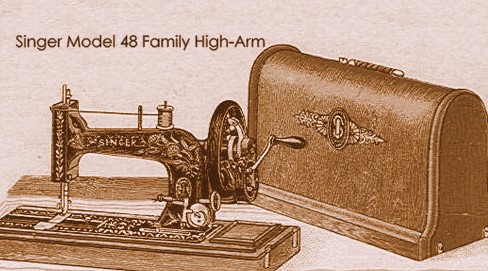
A brief and amazing history of Isaac Singer The Singer 48k Family High-Arm Machine
The Singer model 48 is a bit of an enigma so I shall tell you what I have learnt over the years about this beauty. As usual there is no guarantee as to how accurate my information is and there is a raging debate over this unique model which is fascinating. I wish more machines caused such controversy. The Singer 48 is one of those rare machines where the facts some Internet pages are stating simply don't match up with the figures. So who is wrong... Why, when the figures that some suggest point to Singer producing thousands of these machine was there a complete lack of advertising for them in the same years. We all know Singer were the best advertising sewing machine company in the world so it simply does not make sense that they not advertise the 48k unless they weren't producing it! Some figures suggest in one year over 150,000 Singer 48's were made and yet with this supposedly wonderful selling machine not a jot of advertising. Were people just queuing up to buy an unknown model, dig a hole and bury it forever. No way! I am inclined to believe that the 48k was produced intermittently over a 14 year period and the numbers are not correct. If we are to believe some publicised statistics that have surfaced a production run of nearly 500,000 was started, some say the production run was going to be over 500,000 over a 20 year period. But why was production halted and why do so few turn up? Even in India they cherish the old machines and they would be there in abundance if they ever existed.
I have only seen a handful of these superb machines in a
lifetime in the trade. And to my knowledge only about 100 or so are in
collectors hands making it one of the most sought after of all Singer models. How Rare? After a site claimed the Singer 48k was not so rare I did my own little survey on Ebay and found in a six month period only one model came up for auction. Now if that is not rare I don't know what is. Compare that to the Singer 17/27 or any Singer model of the same vintage, they appear daily. Other models were not supposed to have been made in the same numbers as the 48 but still turn up in their droves today. It is easy to pick up diamonds or gold but you try getting hold of a Singer 48k in great condition. Go on do a search for Singer 48k's for sale right this second and see in the entire world how many come up...Now that's what makes the 48k rare. So why was production halted suddenly with only a fraction of the proposed machines made? Why are the figures not stacking up? Why were production numbers apparently so high yet the machines just don't exist? I feel a Tom Jones song coming on...Why, Why Why Delilah... In fact most of the machines I have seen were made in 1903 date letter R and a few from 1904 and a few later in 1909, V. It is not possible that of all the machines that have survived coincidentally were all made in the same short period, unless that was the best or main production for the Singer 48k. Once again throwing doubt on some published figures. Let's look at the period. German high-arm machines were dominating the European market in the late 1880's and a large production run would not have been out of the question if only Singer could capture some of its rivals German High-Arm markets. Singer was an aggressive company and thought nothing of eliminating competition. In fact it specialised in it. The idea was great but no one saw a World War just around the corner. The internet has allowed us to track down the few surviving Singer 48k's world-wide but the only hot-spot for them seems to be Britain, not surprising as they were only manufactured at Kilbowie, Clydebank, Britain. Now I know you are booking your flight as we speak but carrying back Singer 48k's in hand luggage is going to make the plane fly crooked. They weigh a ton and are still harder to find over here than hen's teeth.
In Britain, where they were manufactured, more turn up than anywhere in the world and they are mainly hand-crank models, though treadles were exported possibly from the late 1890's. Once again this is only hearsay and I believe incorrect as I have never come across a pre 1900 48k sewing machine.
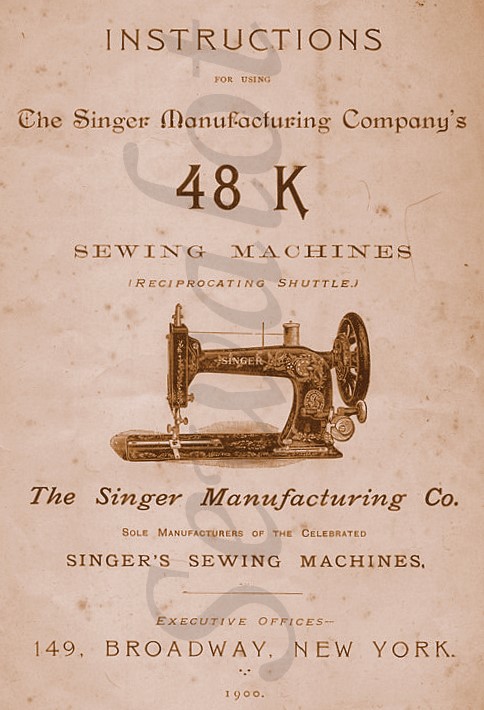
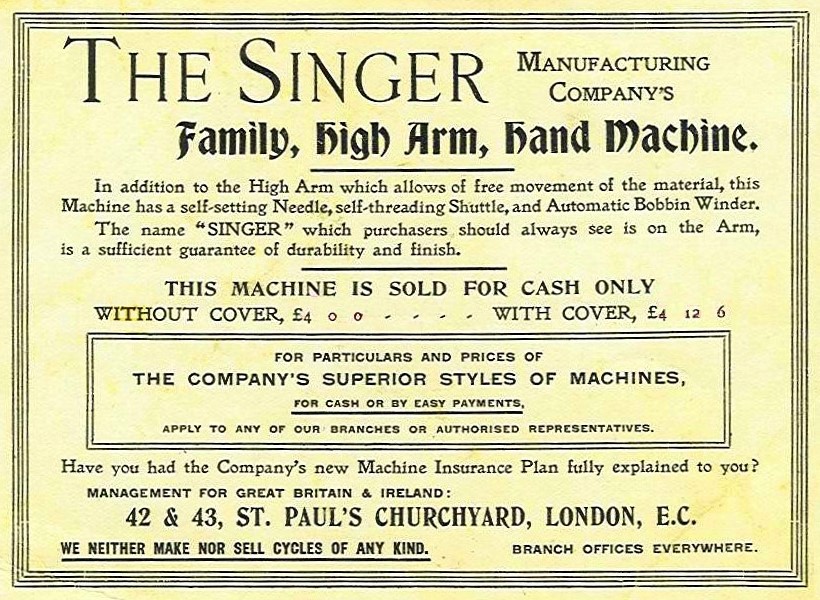
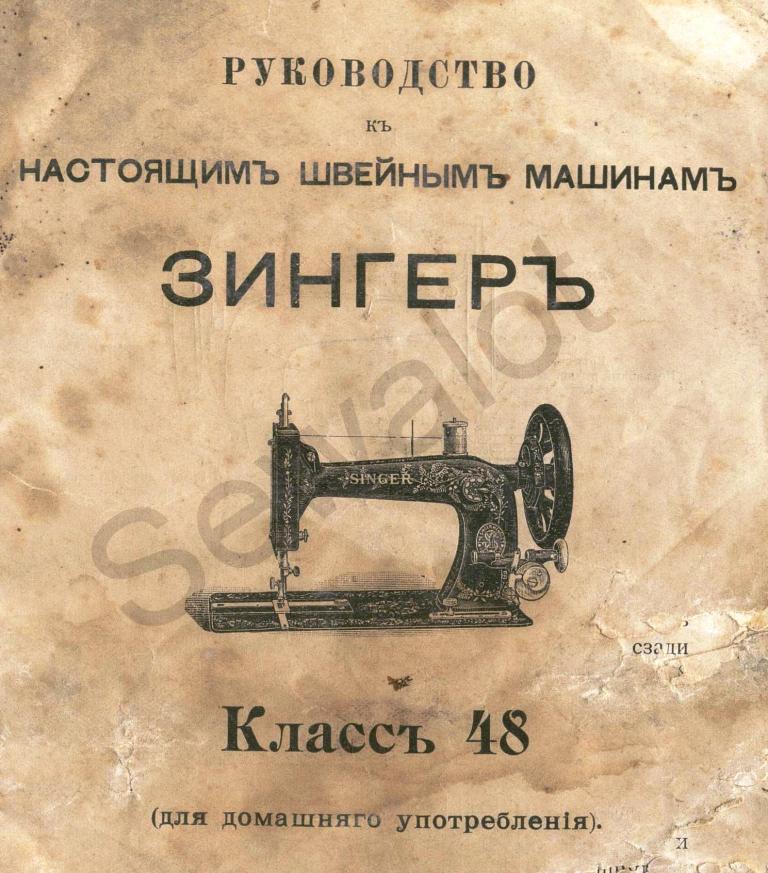
Charles Law's book has an advert of a Swedish-export model 48k treadle dated 1893! There is also mention of a court case for the 48k in the 1890's, Though I am sure production did not really get going until the early 1900's. By 1912/13 it had vanished! None of the models I have ever come across in 30 years have a pre-1900 serial number which throws doubt on the 1893 model mentioned above. A Survey Bill Norwood of Ozark, Missouri, USA, carried out an interesting survey of Singer 48's in collectors hands spanning five countries. There are other surveys on the Internet stating figures that just cannot be proved. Bill kindly allowed me to share his in-depth information. His findings show all the serial numbers dated from 1900 to 1911.The main production period seems to be around 1902-1905. There were no pre-1900 or any later than 1911. Other sites have said that no Singer 48k's were officially exported, distributed or sold in America through Singer dealerships. The models that do turn up there today were bought and brought in by enthusiasts and collectors. Well how do they explain this picture below clearly stating the New York address?
As I have mentioned the Singer 48k was manufactured in Kilbowie, Clydebank, Scotland, and what a beauty. It ticks all the boxes that collectors like. Pretty, unusual, limited numbers and sews like a dream.
The Singer 48k was possibly patented
as early as
1888 the same year as Jack the Ripper stalked the London Streets of
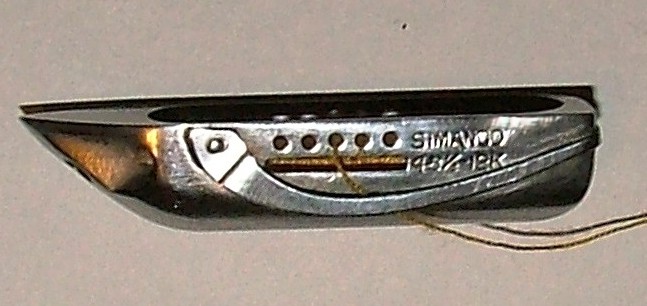
Whitechapel look Although it was possibly patented in that year production usually took years to set up for an entirely new shaped model. Just the foundry castings alone would be a massive undertaking, then all the intricate gears and shafts. So we can assume production probably started in the late 1890's. However, as I have said, I have yet to come across a pre-1900 serial number on the few I have seen. If you have one mail me this instant alexsussex@aol.com Interestingly the only copy of instructions I have ever seen had the Singer 48k but when it came to the attachments it simply copied the old 17k manual. Okay so its not that interesting. The Kilbowie brief was probably simple, the engineers were to design and build a modern forward-looking machine for the new, fast approaching, century. It was to appeal to people buying the old-fashioned German high-arm models. It was to include all the features of Singers best selling, widely-copied, Singer model 12 but with new features to compete with the foreign, mainly German, high-arm machines. Export must have been considered as important as Singers did not nickel plate the normal parts to avoid import duties into some countries. Apparently nickel plate was a sign of luxury and taxed! It was to have more clearance under the bed, improved bobbin winder, improved bearings, better tension adjuster, German style stitch-length slide-knob and a modern boxy-look to keep ahead of the competition. Very Art Deco. Singer 17k shuttle
The first Singer 48 models used both old 12k needles, that most of the foreign machines were using, and later standard new-style 705 needles which are still used today. The machine also had a needle stop to locate it at the correct height. The first 48k models I have come across had a similar shuttle to the Singer 12 but it was shortly replaced with a similar one to the 17k shuttle which is why the instructions worked for both models. In fact the machine was a bit of a mix-n-match combining several features from other Singer models and just a few unique ones.
As well as all their normal machines Singers also had other models in the pipeline, the Singer model 15 was selling well the 66 and 99 were coming on line with no bobbin cases. The Singer 48 was up against some stiff competition even from its own stable-mates! The Singer 48k's days were numbered. Russian Singer Model 48 sold in Moscow 1904
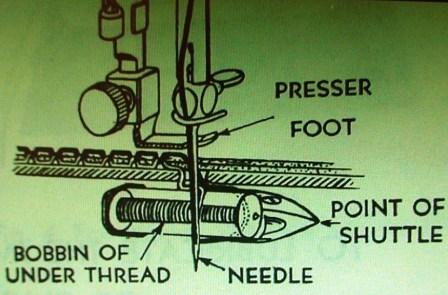
I have more on these other Singer models and pictures, Singer through the years. The big mistake for the singer 48's longevity was using the old transverse or reciprocating shuttle action which produces a slightly tight stitch on most fabrics so it would be the first thing that broke on any fabric with give in it, especially wool. This method of stitch formation was really obsolete by the 1890's and did not compete with the new shuttles and bobbin cases for perfect stitching or ease of threading. One thing I love about the Singer 48 is the press-button tension release. A feature that would have been great on any sewing machine.
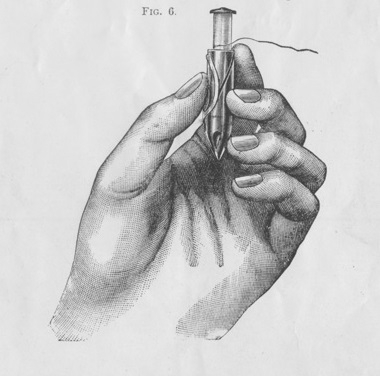
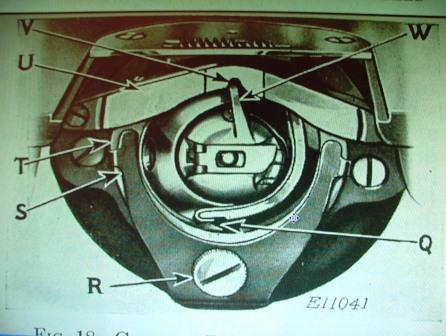
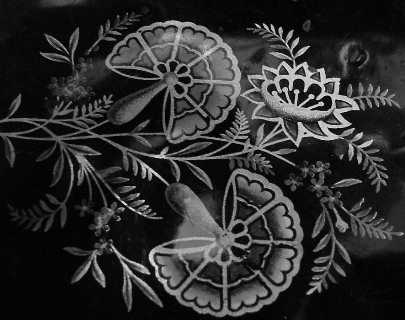
The left picture above shows the old style Singer shuttle known as the vibrating shuttle creating the elusive lockstitch and the right pic shows the later CS or central bobbin system that is still used today by many manufacturers. The big question is why did Singer go back to a an old design even if the German's were using it? It is one of the enigmas that will probably never be answered! The model 66 knocked spots of it for performance. Even the 17/27/18/28 models were better, easier to use. Was the Singer 48 a cheap stop-gap machine. It would explain a lot. It could explain the sudden halt of production and limited numbers produced. It simply did not cut the mustard! Or with the storm clouds approaching and the coming of WWI and the sudden drop of people buying German machines there was no need for this fill-in model to compete anymore. Or, I do love my or's, with Singer involved in arms manufacture did they simply drop unnecessary models from their range? We will probably never know. All 48's had similar decals or design except a few export models which had different motifs on the bed but the same decals elsewhere.
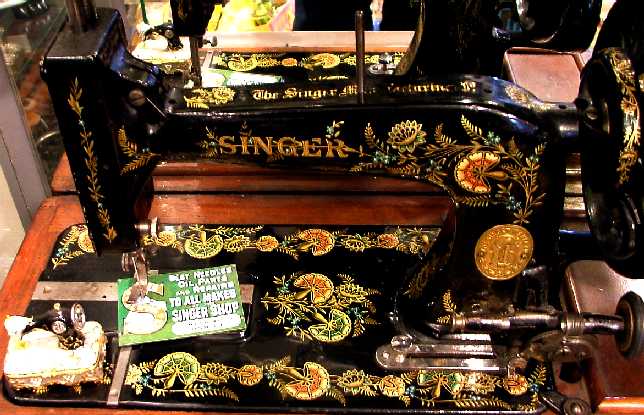
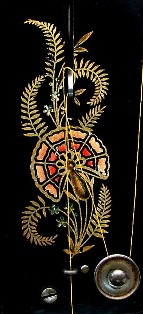
The design, used on several earlier Singer models, often called peacock or orange slice, is actually based on a 15th century Turkish design. It is know as the Ottoman Carnation design and very pretty it is too. The Ottoman Carnation design had proved popular with several Singer designs and fitted the 48k machine to a T. Values Values are high for the 48k, some perfect machines fetching great prices amongst the keen collectors. Put a Singer 12k next to a Singer 48k and you see 40 years of sewing machine evolution in action, a great display for any collector. With the Internet, some 48's have turned up and have been missed by collectors but the ones that do get spotted are always snatched up, so grab one if you can. Always remember there is only three things worth noting in collecting, condition, condition and condition! The one in my collection, pictured above, is a stunner and stitches like new. I had it on display at my local Marks & Spencer's until I realised how valuable it was! Boy did I hot-foot it down to the store and politely replace it with a 17k. Well that's it, all I know about this beautiful and rare machine, which isn't much but I hope it helps. If you know anything you would like me to add do mail me. Bye for now.
See Alex Askaroff on Youtube http://www.youtube.com/watch?v=8-NVWFkm0sA&list=UL
|
|||||||||||||||||||||
|
Well that's it, I do hope you enjoyed my work.
I spend countless hours researching and writing these pages and I love to hear from
people so drop me a line and let me know what you thought:
alexsussex@aol.com
Fancy a funny read: Ena Wilf & The One-Armed Machinist A brilliant slice of 1940's life: Spies & Spitfires
Hello Alex,
|
|||||||||||||||||||||
|
|
|
||||||||||||||||||||
|
|||||||||||||||||||||