|
|||||
|
|
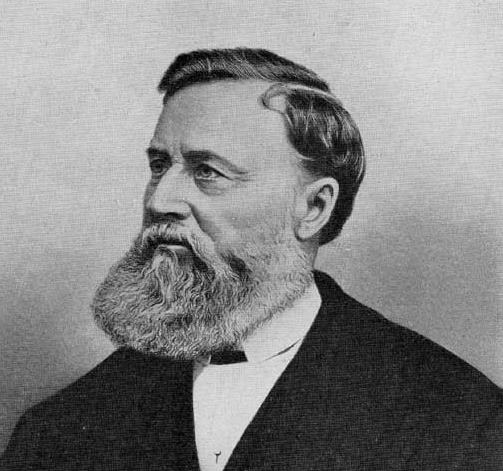
The story of Isaac Merritt Singer is straight out of American folklore. Isaac ran away from a troubled home to a carnival that was passing through his town. From living on his wits Isaac became one of the wealthiest men of his era, long before the great men of American history like Carnegie, Ford and Rockefeller. Isaac's story is one of wars and women, in his will he named over 20 of his children and made each one rich beyond their wildest dreams. Isaac Singer wrote his own history in his unique style and when he died as an old man he was married to the most beautiful woman in Europe, 30 years his junior (cover picture). Isaac's inventions helped kick start the greatest industrial growth that America had ever seen and made it into the first world super power. His techniques, salesmanship and entrepreneurial skill brought jobs to millions of people world wide and made Singer a household name. Isaac's story will blow your mind and may just be the best tale that has never made it to Hollywood
A man touched by fire What a man! When I first started, as a child growing up in the sewing industry, to hear stories about Isaac Singer I was enthralled. He had lived the American dream. A true rags to riches story, then it all went wrong. But in a final twist between wars and wives Isaac Singer found peace. He also founded a dynasty that continues to this day. Out of all the sewing machine pioneers that I have written about over the last decades Isaac Singer's life stands out as simply astounding. Imagine a spiders web that stretches across the globe and in its centre is one man. That man is Isaac Merritt Singer.
Although Isaac Merritt Singer claimed to his dying day that he had invented the first proper sewing machine, he did and did not. What the genius did was to take the best of what had existed at the time and make something better, the first practical sewing machine of the age. He also invented a mechanical digging machine for rock excavation, a rock drilling machine, a wood carving and cutting machine and a printers type letter cutting machine and patented dozens of improvements to sewing machines. With his best creation, his sewing machine, he and his hand-picked men, promoted it with such an astounding flare and capability that it became the number one of its kind in the world. Marketing experts today would do well to examine Singer's methods as they were simply the best. From destroying any opposition to mass give-a-ways and beautiful models, Isaac used every tactic possible to promote his machines.
Let me
tell you about the man who became a household name,
some say known by more people around the world than Jesus.
Isaac Merritt Singer
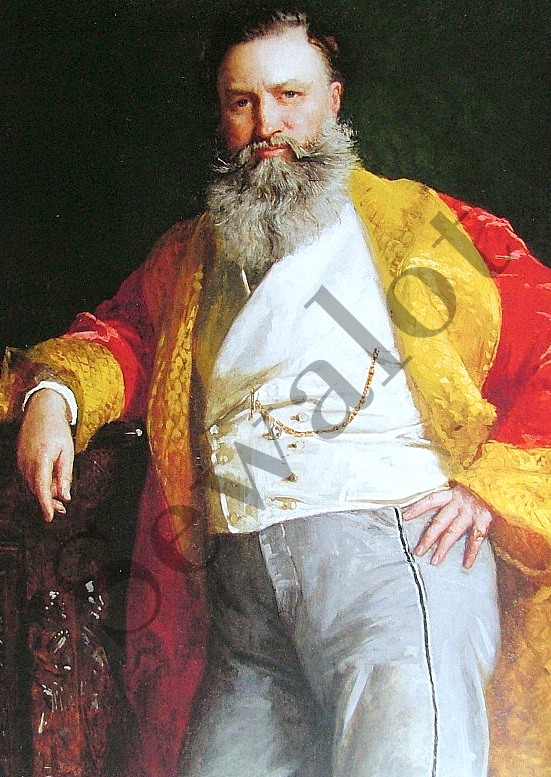
Isaac Singer distinguished as ever, shown here later in life as one of the world's richest men. This picture was donated by Singers to the Smithsonian. It shows Isaac in his favourite smoking jacket. His children loved him wearing it at their palace, Oldway in Paignton, England, as they said it made him look like Father Christmas. He had a touch of red in his hair, was well over six feet tall, had hypnotic eyes, and was totally irresistible to women.
Most of us know the name Singer but few are aware of his amazing life story, his rags to riches journey from a little runaway to one of the richest men of his age. The story of Isaac Merritt Singer will blow your mind, his wives and lovers his castles and palaces all built on the back of one of the greatest inventions of the 19th century. For the first time the most complete story of a forgotten giant is brought to you by Alex Askaroff.
Reviews, No1 New Release
Brenda Cooley
Received my book and have begun reading it. Love the
story and your writing style already. Thank you, Mr. Askaroff. I
even loved the stamps on the envelope - Queen Elizabeth and the By
Airmail Royal Mail. Might try to use the envelope paper and stamps
and make a bookmark for the book. Happy New Year! Brenda, South
Carolina, USA
Kathy McGraw DiPaolo Wonderful read! Pam King Palmer
I read your book in one day! Love it. Thanks so much
for writing it and teaching us so much.
Judy T. Kohlruss - Amazon Verified Purchase This review is from: Isaac Singer: The First Capitalist (Paperback) Reading this book is like sitting across from the author, sipping tea, and listening to take tales of days gone by instead of reading a dryly written history book. It is filled with struggle, corporate take overs, and illicit affairs resulting in a product I could never do without. Amerlia Erhardt "nature adventurer" (Jacksonville, FL USA) Amazon Verified Purchase This review is from: Isaac Singer: The First Capitalist (Paperback) Interesting to read so much about the man who brought the sewing machine to millions of people. Tamsin Monks
Alex please approach the BBC, it would make a
fantastic period drama series! I'm very much enjoying reading your
book at the moment
Dear Alex,
I just received my copy of the new book, Isaac Singer: The First Capitalist, It's wonderful! Thank you for writing the history of this interesting man. Sandra Cohron Alex, To put it simply, you are a superb writer, Rede Batcheller Karolyn Nubin Jensen Alex Askaroff...I got my copy from you...I live in Arizona...I have been enjoying reading it...I love your style of writing and I am amazed at the life of Mr. Singer. Great job! Kathy McGraw DiPaolo Wonderful read! The long awaited book from the amazing author Alex Askaroff - The First Capitalist - Isaac ... 24 Nov 2014 By Mrs. S. P. Brown - Published on Amazon.com The long awaited book from the amazing author Alex Askaroff - The First Capitalist - Isaac Singer. What a book and what a cover - the millions and millions of Americans to whom the Singer Sewing Machine has been a household name for so long will doubtless be racing to the bookstore to purchase a copy of this totally gripping history of the iconic Isaac Singer. It is only a matter of time before a movie will be made of this. How incredible that Alex Askaroff has spent 30 years of his life gathering all this information. It is the must have read for 2014 and what a xmas gift from Santa to pop into the eagerly waiting Christmas stockings. Format: Paperback Amazon Verified Purchase Fast shipping and a good read! I had read much about Singer 29 Nov 2014 By Ponydriver Format: Paperback Amazon Verified Purchase Fast shipping and a good read! I had read much about Singer, but this book went into greater depth about the man himself, and his family. Very interesting!!! Good pictures, too. Wonderfully written!! 25 Nov 2014 By joan sohlstrom
Hi, I just wanted to say a big thank you, I really loved your Singer history, thank you for communicating your knowledge and skill. Tanya Nuttall Mr. Askaroff, Just a quick note to tell you how much I enjoyed reading your new book on Singer and to let you know I received it in Alabama on Dec 6th.The Great Grandson of Isaac, (Paris' Grandson) is buried in this area. Francis Merritt Singer, I actually stumbled across his grave quite by chance while strolling in a local cemetery. Thank you for all of the research. Sincerely, David Brady Shelly Garno Your book is excellent! Received my copy in Michigan USA! Kathy McGraw DiPaolo A very interesting read. It gives me much more appreciation for my sewing machines. Kathleen Dunnigan I received mine in Louisiana and am enjoying it immensely. Very well written. Thank you so much. Shelly Garno Alex, I really love the book and you are a talented writer.
Hi Alex
Isaac Singer was my great grandfathers brother. I Enjoyed reading your story about I. M. Singer. I Have read others, but yours is so much more in depth.
Thanks,
Gary Singer
Dear Mr. Alex Askaroff, Hi Alex I love your information about Singer and the story about the man behind the machine.
Alex I read your history of the Singer family. Incredible! My mother's dad was from Alsace Lorraine, with the last name of "Boyer." Since Isabella's father was South African, is it assumed that her father was White but was he? It would be great, to know if she was possibly Biracial, i.e. South African Black and French. Although, in those days, you'd think everyone would have been aghast. But, you never know, as we are all mixed, when it comes down to it. Thank you. Regards, Margaret US State of Virginia
Hello Alex
Thank you so much for your fascinating information about Singer.
Julie, Western Australia
Hi Alex,
You kept me up last night reading your Singer story I love your writing style. Very interesting, and very indicative of the "rich and famous" of the time. They had a "if you've got it, flaunt it" attitude about money back then. I don't write to many people when I read their sites, but your writing style is so dear to my heart that I just have to let you know.
Marilyn S
SE TX Alex,
USA
Great Site!
My great-aunt was May Bourne Strassburger, she was the eldest daughter of
Frederick Gilbert Bourne, President after GRM. I’m always fascinated by
Singer stories.
Congrats!
Jeff
Jeffrey H. Sado NYC Hi Alex,
BTW I Have seen a photograph of her great great grandfather
with Kaiser Whilhem.
Ed Alex,
Dear Alex,
I discovered your beautiful website today, your illustrations took my breath away! My husband was the 2nd great grandson of George Ross Mackenzie.
Thank you,
Yours truly, Carrie C. Mackenzie Dear Mr Askaroff, Thank you so much for your
informative website. I read every word about Isaac Singer and
loved every minute of it. What an amazing man Isaac was.
|
||||
|
Fancy a good read: Ena Wilf & The One-Armed Machinist 
Dear Alex, My name is Sonia McNulty (nee Anthonisz). I was so pleased to find your interesting book on Isaac Singer. My Cousin Edith Anthonisz was married to Fred Singer, who took over his (I think Grandfathers? empire).
Thank you for taking such valuable time of your own to produce this
fabulous work, and I hope a Film Director will reward you by turning
this into an unbelievable film.
I wish you the best. Sonia
Hi Alex
So when's the movie of Issac's life? Oh
my!! I've always been interested in this family's history, just
purchasing my first Singer antique...a 1947 model 15-90.
I lived many years in the city of
Glendora, CA (near Pasadena) that is home to a Singer mansion or
two. They even have underground tunnels between them to evade
the public.
Anyway, very interesting read. I had no idea!!! Thanks Sam Hi Alex,
My great grandfather was Mortimer Merritt Singer, son of Isaac
Augustus (son of Mary Sponsler). I remember visiting my
great-grandfather when I was about 5 years old, when he lived in
the upstairs apartment of the Rye Country Club near NYC, in his
early 90s. He would give me a quarter for achieving a “cat”
game in tic-tac-toe!
Mortimer Merritt had two daughters, Elizabeth Singer and
Katherine Singer. Elizabeth was a rampant liberal, champion
golfer and tennis player, and graduated from Smith College,
before marrying my grandfather, Herbert DeRieux Lancaster (from
the Lancaster banking family in New York City, previously
Richmond, VA, and also descended from the Plumard de
Rieux family, a branch connected with the court at
Versailles that immigrated to Virginia with Phillip Mazzei in
the mid-1700s).
Elizabeth had two children, my father John Singer Lancaster
(1927) and his sister Dr. Mary Jane Lancaster (1931). My aunt
Jane is an unusually strong character,
obtaining her Ph.D. in geology from Columbia in the 1950s,
serving as Associate Professor of Geography at Boston University
for many years, where as a private airplane pilot she was an
early expert in remote sensing with aerial photography, and
she’s still playing tennis and skiing at age 82!
The Singer fortune lasted about 5 generations, pretty much
disappearing with my father’s and my aunt’s generation. My
grandmother, Elizabeth, favored communist philosophy as a deep
rejection of the extremely wealthy capitalist upbringing she
experienced. My father, having the advantage of a major in
philosophy at Yale, retired to the life of a hermit in rural
Vermont!!
We grew up proud of the sewing machine stories and aware that
Isaac was a “scoundrel.”
Thanks again for your fine and colorful essay! James Justin Merritt Lancaster Belmont, MA Hi Alex
More
books
by Alex Askaroff
on Amazon
Both
Sussex Born and Bred, and Corner of the Kingdom
|
|
||||
Isaac Merritt Singer |
|||||