|
|||||||||||||||||||||
|
|
Alex has spent a lifetime in the sewing industry and is considered one of the foremost experts of pioneering machines and their inventors. He has written extensively for trade magazines, radio, television, books and publications world wide. Alex is a keen amateur photographer. |
||||||||||||||||||||
|
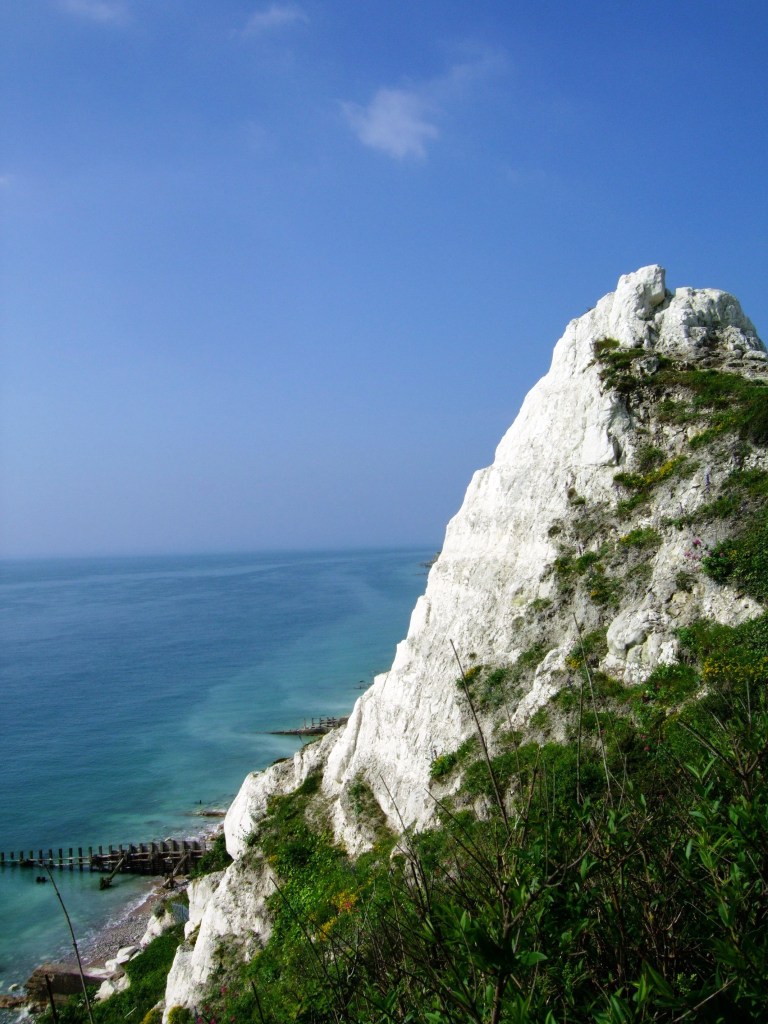
Holy Well and the Sugar Loaf I know I usually write about sewing machine history but this is one place that is so special in my hometown that I must add a page for. Enjoy. No one is absolutely sure why the Sugar Loaf is at the foot of the cliffs just a short walk from St Bede's School in Eastbourne. It was obviously hacked out of the chalk cliff with some great effort and care into a rough point. The reason this pinnacle is most commonly called the Sugar Loaf is that it resembled the early large-lumps of sugar supplied to shops. They would simply slice a lump off the loaf when you called. There are other names for it such as Pinnacle Point, though its ancient name has long been lost in time. I have walked the paths and hills of Eastbourne since a child. Here are my thoughts on this magical place... There is one tale that the Sugar Loaf was put as a marker for early fishermen to find their way back to one of the first settlements in the area. There is another that the Sugar Loaf was cut as a marker to allow boats to line up with the channels hacked and blown into the outer reef of the lagoon that allowed fishing boats through to the lagoon in safety. My own belief is that the Sugar Loaf is far, far older and the tow facts above came after the Sugar Loaf. My reasoning for this is that the very early settlements in the area were at the base of the cliffs at Holy Well. In fact if I were to hollow out a channel for boats I would look for a marker on the downs which was clearly visible and the Sugar Loaf is it. How I would love to have known the old word for the pinnacle. Today we take water for granted but it is humans most basic need and without fresh water we would die very quickly indeed. Here at Holy well they had fresh running water from the cliffs that came out even in the driest summers. There is evidence, some of it in the British Museum in London, of our early roots in Eastbourne. Neolithic, Stone Age Bronze Age, Iron Age, Roman, (Anderida the Roman town is under much of Eastbourne). Although lots of Eastbourne's history has been lost, hidden beneath its earth is a rich seam of clues allows us to see her history. Did you know when the Carpet Gardens were first laid out they copied the pattern of the Roman mosaics underneath. People think that Eastbourne's seafront is quite new but from Holy Well to the Pier it has changed little in centuries. Eastbourne must have seemed like heaven to our ancestors. Settlers had food from the Hills and sea. It was the perfect place, later to be named Holy well. Hollow Place Some people mistakenly think that the name came from where chalk was cut from the base of Holy Well for road construction. A possible abbreviation of the words hollow place. The chalk pit still remains as a garden today where plays are held in the summer. Because early humans assumed these gifts of life could only possibly have come from God. Water, food and shelter. Holywell or Holy well gained its name. In the summer of 2010 the last remaining water source pouring from the chalk hills was blessed and protected. When I was a kid water poured out from several places along the cliff base but in the last 50 years only one spot has remained constant. Much of the time it is hidden by heavy shingle from rough seas. Sometimes it stinks as sea-thrown weed rots at the base of the cliffs. However pull the weed away and move a few stones and as if by magic the spring water is there. Crystal clear and sweet, some say blessed with healing powers though it did not cure my dog's fleas even after a savage wash! People say that some of the water originates from deep within the cliffs from ancient melted glacial waters. The water, forced up by a geological fault between the chalk and greensand and gault clay appears at Holy well. Some say it is the filtered rainwater which can take up to five years to filter through the chalk. Probably both. The fact that it has never run dry even with Eastbourne Water Co, using much of it now leads me to think some of it must be coming from beneath as well as above. Just above the Sugar Loaf and Holy Well are the ancient remains of earthworks left by our early iron age ancestors. St Bede's School now sits on much of it. Apparently around 1450 a small community of nuns looked after the well. These wells are often called Chalybeate wells, referring to the old wells with health-giving properties that are dotted around the world. The nuns possibly disappeared after the reformation when many religious houses suffered from Henry's zealous money gatherings. There is a sweet legend based slightly on facts. In 1862 Mother Harriet, head of her order, came to Eastbourne and Holy Well to recover from illness. After drinking from the waters she found a new surge of energy for life and to repay her recovery she oversaw the building of All Saint's that cared for the sick and is now retirement homes. All Saints is an impressive building but memories of the noises coming from the hospice when I was a child still makes me shiver. In my own way I much prefer the new flats! Sugar Loaf, its age... Now, my reasoning for the Sugar Loaf being made by the first settlements in the area thousands of years ago came to me by chance and I could be quite wrong. Water is our most essential basic need for life. If you wanted to let others know where that fresh drinking water was (not, salt, stagnant or polluter pond water) how would you do that? A sign. A big sign that could be seen from sea or shore from miles away. Now fresh clear water was a godsend and a regular gift like that would have deep religious significance for all time not just to the Pagan, Roman, Druid or Christian religions in our area. It is easy to imagine how important Holy Well has always been until today. The most important times in all religious calendars are guided by the sun and two of those are the mid-summer and mid-winter solstice. Years ago I was walking my dog in bleak mid-winter. It was in fact the shortest day of the year. While walking by the Sugar Loaf I noticed the sun start to come over the horizon. I climbed up the small path, dragging my mutt complainingly behind, that comes up directly behind the point of the Sugar Loaf. To my amazement the sun came up directly in line with the point. I was standing on the path as the sun rose over the sea on a freezing mid-winter morning. It was one of those deeply inspiring moments. If it wasn't for the dog nearly pulling me to my death as it chased a crow I would have stayed longer. It is the only day in the year that the sun does this exactly in line with the path and point. I believe the path and the point of the Sugar Loaf were, besides the marker for the Holy well, cut to precisely mark the Winter Solstice, December 21st. The area is now a bit of a centre for nudists in the summer which shocks our old Eastbourne dears and upsets my dog. Holy Well and the Sugar Loaf are unique and truly special. The area has a feel, an aura. Sometimes the westerly breeze brings all the scents of the wild sea and the stunning views simply fill you with a yearning for life. I can see why so many people including Mother Harriet found this spot so yummy. The white of the cliffs, the blue of the sky, the green hills and ever-changing shore. Holy Well is one of the hidden little secrets of Eastbourne.
|
|||||||||||||||||||||
|
I do hope this has helped anyone
researching the Sugar Loaf or Holy Well.I love to hear from
people so drop me a line and let me know what you thought
and please feel free to use this information: alexsussex@aol.com
Fancy a funny read: Ena Wilf & The One-Armed Machinist A brilliant slice of 1940's life: Spies & Spitfires
|
|||||||||||||||||||||
|
|
|
||||||||||||||||||||
|
|||||||||||||||||||||