|
|||||||||||||||||||||
|
|
Alex has spent a lifetime in the sewing industry and is considered one of the foremost experts of pioneering machines and their inventors. He has written extensively for trade magazines, radio, television, books and publications worldwide. Over the last two decades Alex has been painstakingly building this website to encourage enthusiasts around around the Globe.
|
||||||||||||||||||||
|
Wanzer Sewing Machines
A brief History
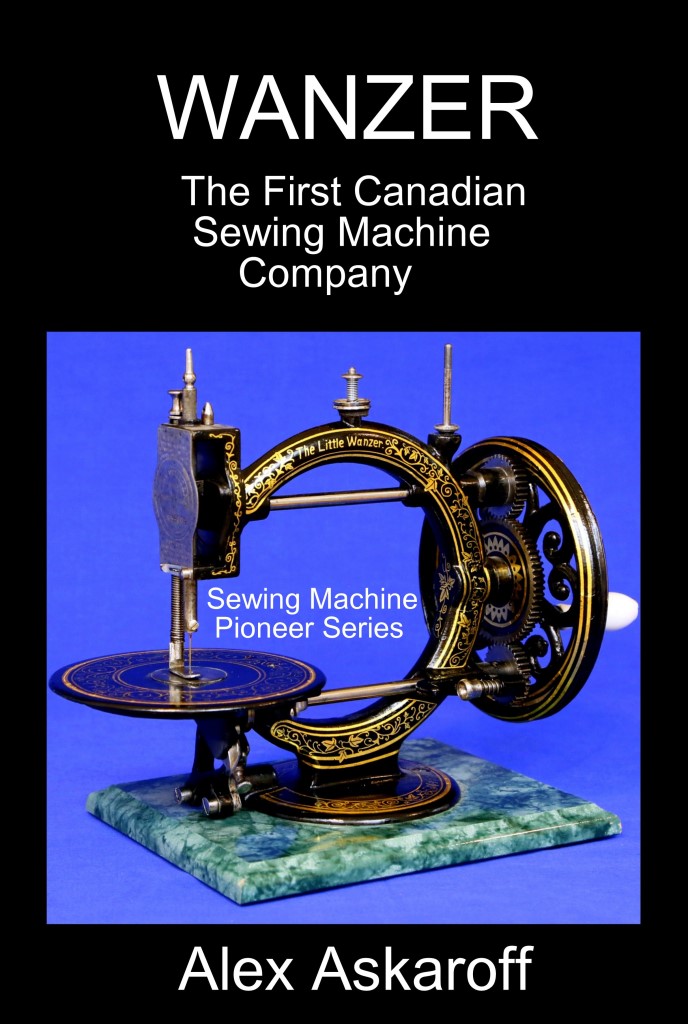
The first Canadian sewing machine, Little did the Quaker parents know, when the screams of their newborn child echoed around their little farmhouse near Ithaca, New York on September 3rd 1818, that they had ushered into the world the man who would go on to become the first pioneer of Canadian sewing machines and the maker of the finest sewing machine in the world in 1875. Richard Mott Wanzer grew from humble beginnings from that harvest time in 1818 into an immensely wealthy entrepreneur and business man, then he lost the lot. This is a just little of his story that I have put together over the last 25 years. I have to thank many of you that made this article so complete including the Hamilton Public Library and Margaret Houghton who added some invaluable details from the Hamilton Library local history archives. There needs to be some clarification as to where Richard was actually born because I was sent this family record from Poughkeepsie, NY, which is around 150 miles away from Ithaca. So if you have any detail please let me know so that I can clarify the following Wanzer family... Husted Wanzer, born around 1808. Haviland Wanzer, born around 1810. Henry Wanzer born, around 1812. Richard Mott Wanzer, born 1818, Sarah Wanzer, born around 1820. Isaac Wanzer, born around 1822. Anne Eliza Wanzer, born around 1824. All in Poughkeepsie, NY. Were these his brothers and sisters? Let's stick to what we do know. There are no school records for Richard Mott Wanzer and it is highly possible that he was home-schooled. Although self taught he was highly educated and intelligent. He was also eager to make his fortune. For a brief period as a young man Richard Mott Wanzer taught in New Bedford, Massachusetts and then moved to Rochester, New York, where he became a book clerk. As an adult Richard was working in New York City repairing early sewing machines that were full of flaws and faults. Richard had the repair agencies for Wheeler & Wilson and Singer sewing machines. He was very familiar with these early models and they were the first machines that he would later copy in Canada. The daily New York papers were full of the extraordinary battle, played out in public view, of the giants in sewing machine business. Working behind a print works he was close to all the news. He knew the potential of the sewing machine if only he could somehow get around the sewing machine patents and law suits he could easily start a new business. Richard, at heart, was a budding entrepreneur. Copying good ideas was something that Richard would do many times with sewing machines, lamps, heaters and more. During the 1850's, sewing machine production was being severely crippled by a handful of powerful men who held all the patents. Production of the world's first mass-produced machines was grinding to a halt because of constant court cases. Money was being lost in time-wasting litigation. Why? The main instigator of the litigation was Elias Howe, closely followed by Isaac Singer. Although Isaac was never credited with any major invention in his part of the sewing machine history he was sneaky enough to buy up any patents that he could, to protect his market. Elias Howe had established, in the American courts, that it was he who had patented the first lock-stitch shuttle machine (and needle with an eye at the bottom end). In reality his patented machine never worked and only after modification did it mange to stitch at all. Even after public displays no one wanted his machine. After years of trying to sell his machine he decided to stop everyone else selling theirs. The Little Wanzer shuttle. Elias Howe owned two incredibly important patents in regards to the manufacture of sewing machines. The needle and shuttle. Now the law is the law, however wrong in this instant. Howe had not invented the sewing machine but he had patents and patents could be protected. His fanciful meandering reasons of how he came about his invention are pretty far-fetched. His idea of the needle with the point at the bottom end came to him after a dream where Native Indians were firing arrows. One arrow flies through a wigwam and pulls a thread with it. Yeah right! While all this was going on Richard had a workshop and shop in Buffalo and was actually repairing Singer machines. It is very possible that he knew Isaac Singer which may account for Isaac's leniency with Richard when he later copied Singer's machines in Canada. Some sources say that Richard Mott Wanzer was friends with Isaac Singer which is why Singer let Richard get away with copying so many of his sewing machine ideas in Canada. I doubt if this is true, everything that I have ever learnt about Isaac Singer shows him to be a cold-blooded and ruthless business man. The idea that Singer would let Richard Wanzer get away with using his patents is like King Henry VIII not minding that one of his wives sleeping around! Impossible. Singer dealt with all competition the same way, he destroyed it. Basically Wanzer in Canada was a Yankee and serious competition but there was nothing that Singer could have done. If Isaac Singer ever did business with Richard Wanzer for patents and sewing machines there would have been money involved. Isaac's nature was simply not that way inclined. The plain facts were that when Richard was in Canada he had legal immunity from the American patents. Prior to 1869 non-British patents could not be extended or protected in Canada, they simply did not apply. However I am jumping way ahead of the story so we must go back a step or two, back to the 1850's. I hope you have put the kettle on and are reading this with a nice cuppa tea? So, in America, we have all the big boys doing battle over sewing machine patents, Singer, Howe, Hunt, Wheeler& Wilson, Grover & Baker. No one was making any money, except the lawyers. Eventually many of these men combined to form the Sewing Machine Combination which held a strangle hold over the sewing machine manufacturing businesses in America. Coincidentally Richards business had been in close proximity to local printer and publishers. Daily walks and meetings led to a partnership. During the 1850's Richard went into a publishing business with O G Steele, president of the Buffalo Gas Company. One of the more successful publications in 1852 was the anti-slavery novel, Uncle Tom's Cabin, written by Harriet Beecher Stowe. But as it all went pear-shaped Richard decided to fall back on his sewing machine knowledge and came up with a cunning plan. Richard Mott Wanzer saw all the legal problems with patents going on in America and decided to side-step most of them. He would simply move out of America, copy the sewing machines that were selling the best and manufacture them himself, away form the American courts and their patent protection. Where to go? The closest place was Canada. And so in the Autumn of 1859 Richard Mott Wanzer packed up all his possessions and headed fro Hamilton. 54 miles later he arrived at his destiny.
1859 When Richard arrived in Hamilton it was a bustling town with great railway links thanks to the arrival of the Great Western Railway in 1852. I find it surprising that although Hamilton today owes much of its rich industrial heritage, architecture and prosperity to men like Richard Wanzer there is so little about him in Hamilton. Hopefully one day the man who helped build the great city will one day be recognised there. At one point one in 30 of the entire population of Hamilton worked for Wanzer and many more benefitted from his businesses. He was so instrumental to Hamilton's success that when his business failed unemployment and recession hit the town incredibly hard. Back to our journey with Richard. In 1859, with sewing machine patents for Canada and Europe in the pipeline, Richard, with his nephew, set up shop on the corner of Vine and James Streets in Hamilton, Ontario. The factory grew and grew until it was bursting at the seams. More factories were to follow. This was the largest of the Hamilton Wanzer factories on the corner of James Street, four massive stories with the spare parts, counting and shipping rooms on the ground floor. Richard Wanzer made no secret that his first two machines were actually Singer and Wilson machines. He even advertised them as such. What was very clever, was the way he altered parts of the mechanisms such as the shuttle. Most machine shuttles were travelling horizontally, Richard simply copied the idea but moved his shuttle in a vertical sweep. Using the Singer shuttle in his first machine was a brilliant idea. Stand with a tennis ball in your hand and sweep it horizontally left to right. Now swing the ball over your head in an arc, forward and back. It was these sneaky changes and the fact that he was manufacturing in another country that allowed his business to flourish outside the infamous Sewing Machine Cartel.
The factory on the south-west corner of Vine Street, Hamilton, started small and to begin with Richard Wanzer only employed 12 men to produce his sewing machines. This was slow and in the first month only five complete sewing machines were hand-built. Within a few years Richard's factories in Hamilton were producing over 2,000 machines every six-working days. WOW. Now, back to our four sewing machines. Richard Wanzer's Quaker upbringing meant that he was a hard worker and knew the land-people. Once his machines were made, Richard would travel around the homes and farms of Hamilton selling his machines and gaining orders. He would take a wagon and travel to the farms and houses with his machines on the back. Each week he would return to collect more machines and set out again. "Why Maam you don't even have ta pay it all in one go. you can pay by instalments, week-by-week for hardly a red cent. And just look at all that money you can save and all the pretty clothes you can make. Here take one on loan, I bet my new hat you will wanna buy it next time I pass by." This is a true entrepreneur we are talking about here. A man that would go in 10 years from sleeping in the back of his wagon to living in the grandest home in Hamilton. Don't you just love these tales. Can you stop and think for one second the hardship and the pleasure Richard would have gained during these pioneering years of the 1860's. Here he was just 41, he had his own business and he was going to make it work. He would have filled his wagon with feed for his horses and parts for his machines and set of for the week. I can imagine him sleeping under the stars, cooking on an open fire and occasionally being asked in at a farm to sleep in a real bed. How wonderful. All this hard work paid off for after only a nine months Richard Wanzer was too busy at his factory to sell direct. From this time on a fleet of agents grew and were procured around the world. By 1867 the factory was knocking out over 360 machines a month and employed 115 workers. Within 20 years Wanzer had agents in nearly every major city in North America and Europe and employed over 800 men women and children in Hamilton alone. He had become Hamilton's most successful entrepreneur and business man. Richard carried on copying Singer's ideas including his brilliant hire-purchase schemes which allowed part-payment for his machines. This determination and dedication proved a great success. Due to his early experience with the faulty Singer and Wilson machines his machines contained improvements which ensured happy customers and long life to his machines. By close observation of the defects of all other sewing machines the Wanzer inventors have avoided every single problem that has hitherto been found objectionable in the inferior machines of their competitors. Each machine will be delivered in perfect working order and ready for use. Operators with little experience will find no difficulty in using the finest sewing machine yet produced in our modern age. Sorry once again I am rushing ahead. Let's go back a little. On February 19th 1862 Richard Wanzer and his team had their first patents regarding sewing machines granted and the first unique Wanzer machine appeared on the market later that summer.
1862
The unique patents for his first real Wanzer must have been a great celebration for the 44 year old Quaker. For the next few years his patent protection would allow his security and succes. Richard Mott Wanzer's first unique machine was called the Little Wanzer and became know as the Little Favourite.
The Little Wanzer was advertised as the most complete family sewing machine ever produced and was an instant success. His shuttle machine initially sold for $25 or $30 with iron monopod treadle. There were loads of options, cabinets and attachments. Today one of these monopod treadles is worth a small fortune. Just imagine if you had a time machine, just simply store a hundred of these basic monopod treadles and today your $500 investment would be worth around $100,000. Not bad. The machines were priced well below the oppositions as he did not have to pay royalties to the Sewing Machine cartel. A string of patents followed as his team diligently patented every unique device they introduced. Richard Wanzer had learnt the hard way watching Singer, Howe, Hunt and others trying to destroy each other. He protected each and every new improvement as he went. Richard Wanzer was soon too busy to go out selling machines to the farms himself and he concentrated on expanding the factory and the world-wide business. New models were soon to follow. The outstanding success of the Little Wanzer was undeniable, within two years over 15,000 machines had been sold. Small, light and cheap in comparison to other machines the Little Wanzer was an instant winner. Even today the Little Wanzer is a superb machine. The machines flew out of the factory gates as quick as his growing workforce could make them. Even the Queen of England was said to have been impressed and an order from Windsor Castle was placed with Wanzer's British agents. "One thinks one might enjoy a little Wanzer do fetch one my good man." The most perfect of all sewing machines the Little Wanzer
Over the life of the machine over 1,000,000 Little Wanzer's were produced. Due to the pretty shape of the machine it is a machine all collectors love to have.
Some later Wanzer patent dates AMERICA The first Little Wanzer machines side plates, covering the needle bar assembly, were plain but soon they contained a host of information and patent dates including the company trademark of an egg timer/ hour glass or Time Utilizer. It was the perfect trademark for like the washing machine it saved countless hours of labour. Lighter and smoother than any sewing machine yet manufactured
The little Wanzer was possibly the best sewing machine in the world during the 1860's. Being in Canada production was unaffected by the American Civil War. In fact Wanzer was in the enviable position to be impartial and could fill demand for both sides of American markets, North & South. In the 1860's Richard's business flourished. R. M. Wanzer & Co Sewing Machine Manufactory As the business grew new larger premises were acquired at 128-130 King Street East on the corner of Catherine Street. If you live in Hamilton please do let me know if these places still exist. I am writing this on the far side of the world from there. Now Richard Wanzer was in partnership with John Tarbox. By 1872 his four-storey factory was in full production but it was still not enough. In 1878 another larger factory was built on the corners of Barton and Elgin Streets. By now Richard was employing a workforce of over 800. Every family in Hamilton was in some way connected to Wanzer. The very prosperity of the town was flourishing.
Can you imagine the size of his factories and foundries. The noise and smell of hot iron being forged in the furnaces, the smoke from the huge chimneys. Hamilton had become the centre of the Canadian sewing machine industry and while many new businesses sprung up, none matched the size or output of Richard's eight factories.
At the height of production the Wanzer Sewing Machine Corporation were producing 2,200 complete sewing machine every six working days! This also included the wooden cases and iron treadles, marble bases and a million other smaller items. The iron cast treadles were something that Richard was producing, even before Singer, who's first treadles were wooden.
Another benefit of the mass-production was standardisation of parts. If any part were to be replaced it would work as well as the original. Something that many hand-made machines of the same era did not. Each part was unique and had to hand fitted by an expert. With the Wanzer sewing machines any competent mechanic could put a part in and hey-presto it worked.
On the ground floor of his main factory were impressive show rooms containing all his fine machines. Expert demonstrators were ready to display and train agents and customers alike. Expert training at any of our branch offices or agencies is available at request with head office, They will receive prompt attention from our courteous and experienced staff.
Anyone in Hamilton got a new picture for me... pretty please? alexsussex@aol.com Just think how busy the Hamilton railway station was loading up machines that were being shipped all around the world. All these machines were being moved by horse and cart, 24 hours a day. And where did all the marble come from for the Little Wanzer?
The finest sewing
machine in the world in 1875
As Richard's range of machines grew he produced a machine for all types of sewing from boots and horse rugs, to silk and satin. His first machines were the Singer and Wilson copies, one and two. Then came his 1862 patent lockstitch, his first real best seller, the Little Wanzer, followed by my favourite the Wanzer model A. Then B, C, D, E and finally Model F. All these machines were produced between 1860 and 1889.
The late 1860's and 1870's were Wanzer's best years, Awards honoured his machines and exports flourished worldwide. By 1868 another factory was being built in Hamilton on the southeast corner of Catharine and King Street. Eventually, at its prime over 400 highly skilled workers manufactured machines from that factory alone. With money invested by Edward Gurney, Richard Wanzer established European patents and businesses in Paris, Hamburg, London, Dublin and many other cities. The Wanzer Company obtained a lucrative school contract in Ireland and today Wanzer machines still turn up there. Agents and depots opened all over the globe. Richard Wanzer personally over-saw the establishment of the Great Portland Street business in London and between 1867 and 1871 he personally took charge of the London office. Between 1871 and 1873 Richard endlessly travelled the globe winning award after award and drumming up business from Istanbul to Alaska. While in London Richard Wanzer invested £40,000 in the Wanzer smokeless Lamp Company. The use of a small hidden fan negated the need for a chimney and made for a smokeless, clean burn of the lamp. However I am going to stick to my sewing machines. While in London Richard Wanzer personally attended and promoted his machines at exhibitions and events. One fabulous exhibition in Paris, the Paris Exposition Universelle in 1867, was attended by nearly one hundred sovereigns, princes and princesses from around the Globe. Richard Wanzer personally demonstrated his machines to the Emperor Napoléon III and his Empress, Eugénie de Montijo. Wanzer machines won first prize in his class at the glittering exhibition and he was personally awarded the gold medal by the Emperor. Richard had come of age and was now living the high-life. After this great achievement Wanzer took orders for over 12,000 machines! Mama-mia. More medals followed the same year in Britain. Cheltenham, Manchester, York, Dudley and London. Richard Mott Wanzer had produced one of the finest sewing machines of the period and one of his personal favourite achievements was to beat the famous British sewing machine pioneer, Newton Wilson. Wanzer machines destroyed all opposition for quality and price. Our Hamilton man had come of age. For the next 20 years Richard could do no wrong. In 1873 Richard Mott Wanzer personally received the gold medal for the finest sewing machine in the world at the Vienna International Exposition by non other than Emperor Franz Joseph.
By 1878 a purpose built factory rose from the ground in Barton Street, Hamilton, costing an astounding $300,000. Space was at a premium in Hamilton but Richard was sneaky and managed to kill two birds with one stone. I'll explain in a mo. The Barton Street factory was to become the most advanced building in the world at the time. Today it would be comparable to something that NASA work in. Periodicals of the day were amazed at the weird machinery, some working completely unaided by human hand. It was automation decades before Henry Ford.
How Wanzer managed to get the land was brilliant. In 1878 Wanzer bought out the Canadian Sewing Machine Company, started by George and John Webster. The factory had grown up in Barton Street, Hamilton and this was how Richard was able to gain the space for his futuristic factory. To start with the factory was small in comparison and only employed 77 men. It was soon converted to help produce the 100,000 machines a year the company was now pouring out.
All this time Richard kept up his entrepreneurial streak, buying up such ideas as an automatic lamp invented by Abel Heath and a cooker similar to Walter Hunt's Globe. The Wanzer Model A. The greatest mechanical success of its age
The Fall of an Empire By the middle of the 1880's Richard's empire was under attack from all corners. Richard was a prominent Hamilton business man and the largest employer in the area. His responsibilities to the community were huge. One of his patents involved street lighting, so even the streets of Hamilton were being lit by our man. In 1885 as Richard Wanzer looked to diversify he bought the Royal Electrical Company franchise for arc street lighting and converted the street lights to electric. The power station in Hamilton was where the old bus station stood.
The Wanzer Oil Lamp, Colza Oil Lamp, they are rare and very sought after. They were made in their thousands at two factories, one at Niagara Falls. Both companies collapsed during the 1880's recession. Though Richard did later regain the patent and resurrect the lamps. It was said that Richard copied this lamp. What made it so popular was the wind-up fan which allowed it to burn without a chimney. The fan created its own draught and so no glass chimney was necessary. This did leave an open flame. Funnily this is one of the reasons the lamp is so rare today. Many were throw away as people thought that part of the lamp was missing. The fan meant that it also would burn oil which other lamps would not such as rape seed oil. This lamp has been modified to take a glass dome but you can still clearly see the wind-up key for the spring-loaded fan.
End of an Era for Hamilton Several factors combined to bring down Canada's largest sewing machine manufacturer. You know the old saying the larger you are the harder you fall. None was more true that Richard Mott Wanzer.
The Little Wanzer Monopod Sewing Machine. Richard not only made the beautiful cast base in his foundry but he sold the bases to his rival Canadian sewing machine manufacturer Charles Raymond for his New England machines. Several rare Weir/Raymond monopod's have turned up all on Wanzer bases. Another interesting fact is the cases all had the same locks as Raymond's. Were they sharing parts? It is interesting to note that although Hamilton was the centre of the biggest sewing machine company in Canada hardly any Wanzer machines turn up there today. It is almost as if history has been wiped clean on Hamilton's most prolific entrepreneur. I can see a museum opening and a great coffee shop in Hamilton. Any takers?
Why was it all going wrong? As the patents ran out protecting all the sewing machine manufacturers of old like Wheeler & Wilson, Grover & Baker, Howe & Singer, new small firms sprung up and could make and sell cheaper machines. They were legally able to copy all the old patents, like the shuttle and rotary hook, just about any of the early inventions. Small overheads and low profits meant they could churn out cheap machines on their new automated machinery. Poor old Richard Wanzer was being out-done by the very method he had used all those years ago to get around the Sewing Machine cartel. How ironic. These new small companies, with low running costs and small staffing, could make a sewing machine at half the price of the big boys. They sprung up like mushrooms, undercutting and out manoeuvring the heavyweights. Pop in a huge recession in North America and you have the perfect mix for bankruptcy! If you read the poor print below you will see Wanzer's desperate attempts to halt competition, the wording...Caution, Spurious imitations are being offered by unscrupulous dealers!
One by one the big companies started to suffer, Howe, Grover & Baker, Wanzer and later Wheeler & Wilson. The recession of the 1880's led to more and more problems. Singer's seemed immune. Their world-wide expansion meant that the North American recession did not have the same devastating effect. Also Singer's were marketing experts spending over $1,000,000 a year on advertising. By 1880 nearly one third of the worlds sewing machines were Singers. Within two years the Wanzer company had gone from expansion with sewing machines (plus Richard had started two other lamp manufacturers, one in Philadelphia), to ruin.
Whatever Richard tried to do to save his empire, it all failed. Richard Wanzer pumped in $50,000 to prop-up his struggling factories and staff but it was to no avail. Slowly he had to drop production and lay off workers. This was deeply painful to Richard who was known for his generosity and many workers had become his friends. Trains were no longer bulging with Wanzer sewing machines from Hamilton. By 1898 poor old Richard was badly in debt, terribly over-extended at the banks and financially ruined. All his hard earned wealth was gone. Had Richard been more cold-blooded and sacked a lot of his staff, downsized quickly, and cut prices he may have saved a part of his empire but that was not in his character. He was true to his family, workers and friends. This was probably his Quaker upbringing. It cost him dearly.
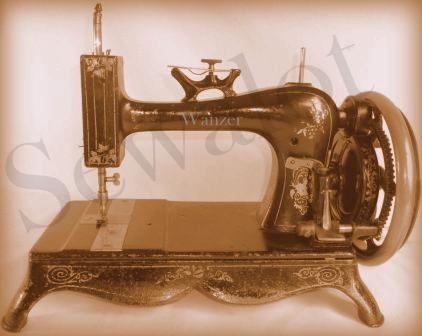
The Little Wanzer treadle sewing machine is still by far the most sought after of all the Hamilton models. I have never seen one after a lifetime in the trade.
Finally the Wanzer Company closed and by 1892 it was no more. Nearly 800 workmen and their families were out of work. Thousands that relied on wages from the plants in Hamilton suffered and a deep recession followed in the area.
Canada's most successful sewing machine business was gone forever. More bad news was to follow.
His lamp business at Niagara Falls, the Oneida Lamp Company, failed as did his soap business. It all ended with poor old Richard being declared bankrupt. The rest of his business assets and even his home was seized. Our Quaker was at rock bottom and none of it was his fault. He had worked his little socks of all his life to be outdone by time and fate. Every single reason for his company demise was out of his hands. Who is going to plough a field by hand when he can buy a tractor? Who is going to take the canal instead of the train? The one thing that he could have done if he had known the future was to sell the whole lot 10 years earlier and retire, he was 74 when all this happened. Still it is always easy to criticise with the marvellous benefit of hindsight. It is not quite the end of the story, for Richard was made of stern stuff and you cannot keep a good Quaker down. Richard had come from a long line of Quakers of Dutch origin originally from Pennsylvania, Connecticut and New York. Rather than suffer the constant humiliation of daily life in the town that he once almost ran in 1898 Richard decided to go back to his roots where it had all began.
Back in Buffalo with his wife, Electa Ann (Lyon) whom he had married in Cayuga County, and his two children, Richard tried to settle down to retirement but that was not in his character. He was still an entrepreneur at heart and had tasted the sweet taste of success. As an old man, Richard tried once more to resurrect his lamp and stove ideas. One of his friends, Senator Sanford, bought back the rights to Richard's lamp (Which he had sold when he lost everything) and let him have it. From this Richard was able to make a comfortable living.
At the age of 82, still working, Richard caught pneumonia. He died on March 23rd 1900 in New York City, back where it had all started 60 years earlier. He had outlived nearly every early sewing machine pioneer. He had made a fortune, got to the top, and then lost it all. He had dined with statesmen, kings and senators, lived the high life and brushed shoulders with the pioneering giants of the age. Famous, and highly regarded in Hamilton, his body was laid in state at Hamilton City Hall. The town had never forgotten how he had helped bring about their prosperity in those early years. The big hearted man was remembered as the perfect gentleman. Richard Mott Wanzer had lived the dream. He is buried in Hamilton Cemetery. His third factory still stands in Barton Street where you can just see his faded name on the chimney stack. Today much of Hamilton has been shaped and influenced by this forgotten hero from Hamilton's past. Richard Mott Wanzer 1818-1900 I would love to have another picture of Richard Mott Wanzer, there must be more out there of such a famous man. If anyone in Internet land has one please mail me: alexsussex@aol.com
The End
A brief
history
|
|||||||||||||||||||||
|
Well that's it, I do hope you enjoyed my work.
I spend countless hours researching and writing these pages and I love to hear from
people so drop me a line and let me know what you thought:
alexsussex@aol.com.
Also if you have any information to add to the page please mail me.
Thank you very much for posting this online Alex. I was living there
with Thanks for sharing this excellently related bit of history!
Hi Alex, I enjoyed reading your article
about Wanzer. His machines come up for sale once in a while in Quebec.
I never paid any attention to them. I will now!
Monica D
Alex, that is fascinating! A very good read. Linda at Relics
Thanks, Alex,
I just read the Wanzer story on your sewsalot.com site. I had not the slightest knowledge of this great chapter in industrial history, nor ever would have, without your work. What fascinating people, and what good people, created our heritage. Wanzer seems to have been quite unlike the "greedy robber barons of industry" that we always learned about as the founders of great fortunes. Your site is very original and interesting, and it's a blessing. Champaign IL,
From: "Sally W"
Fancy a funny read: Ena Wilf & The One-Armed Machinist A brilliant slice of 1940's life: Spies & Spitfires
|
|||||||||||||||||||||
|
|
|
||||||||||||||||||||
|
CONTACT: alexsussex@aol.com Copyright © |
|||||||||||||||||||||