Home of the Sewalot Site


By Alex I Askaroff


For antique and vintage sewing machines


Home

Machines for Sale

Valuations

Books

Our Collection

Reviews

Stories

Index

Pictures

Renovations

New Stories

Poetry

Fault Finder

Tension

Links

Sewing Machine Fault Finder                     Sewing Machine Tension Problems

Wheeler & Wilson

A Brief History
By
Alex I Askaroff

  Main Index                           Skylark Country


                Alex I Askaroff

Alex has spent a lifetime in the sewing industry and is considered one of the foremost experts of pioneering machines and their inventors. He has written extensively for trade magazines, radio, television, books and publications world wide.


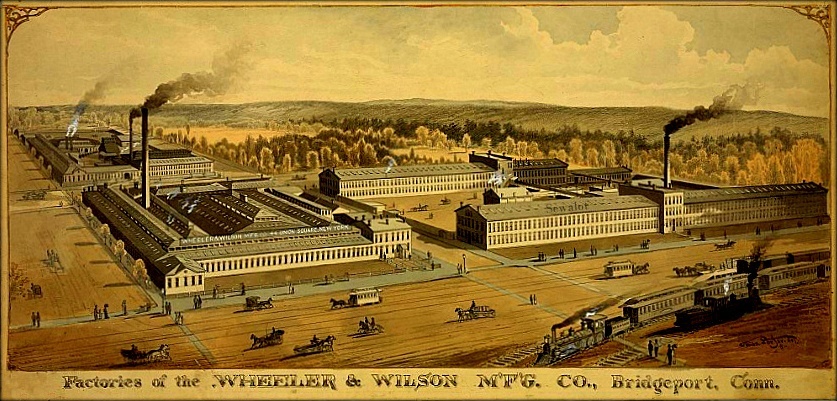
Wheeler & Wilson are names we hardly hear today, but once they were the largest sewing machine manufacturers in the world. The massive factory at Bridgeport, Connecticut, covered acres of ground and the chimneys blackened the air with smoke from the forges beneath which were working the hot metal for the new era of invention.


In its height Wheeler & Wilson had huge factories and employed thousands of workers.

It all started way back in 1841 with Allen B. Wilson, an inventive 17 year old. He tinkered with the idea of making his own sewing machine. An apprentice cabinet maker in a family business he yearned for something bigger and better. Plagued with poor health and a nervous disposition he had the spare time during his illnesses to build working models of his ideas.


The Wheeler & Wilson No 9 advert 1902. A stitch in time saves nine!

Now his first ideas were nothing like the machines we see today. His feed mechanism for tugging the work along was a bar that gripped and pulled the work. His shuttle was a weird double-pointed affair that produced two stitches with every back-and-forward movement. However from these early ideas he then produced several startling and innovative pieces of engineering.

His best idea by far was the rotary hook mechanism. Simply, it went round and round and round, in smooth never- ending circles. On its travels it picked up the top thread from the needle with a little point, twisted with a thread from the bobbin and let it go. So simple and smooth that it would last a lifetime. In fact it ended up lasting forever because most machines today still use his simple mechanism.


The rotary hook of Allen B. Wilson, note the glass see-through foot.


No sewing machine had used this idea and seeing as how humans had been trying for centuries to figure out a perfect stitch this really was genius. If you turn a W&W machine it is so light, smooth and quiet you would be forgiven for thinking it was made recently, not back in the dawn of the great sewing machine age.

His second stroke of genius is more in dispute. He needed a better method of moving the cloth through the machine. At the time people were trying rows of pins and other silly ideas. He came up with a set of teeth that appeared, as if by magic, from under the work, moved the work forward and then disappeared again. People looked on in amazement at this black art. It turned out to be no more than simple engineering brilliance, well ahead of its time. Or was it!

Coincidentally the Grover & Baker sewing machine used a very similar method of moving the work forward. So who was first? No one would back down so it all ended up in court. Now Allen B. Wilson had already been cheated out of one of his earlier patents when Kline & Lee conned him into believing that his double pointed shuttle was really a copy of their 1848 Bradshaw Patent.

In that case, Wilson gave up without much of a fight and allowed Kline & Lee to take half his patent rights for the shuttle. Eventually he relinquished full rights to the shuttle. Good riddance to bad rubbish he must have thought. Mind you he did get $2,000 for it in 1850. A large sum by all accounts.

The great idea of glass sewing feet to look through when sewing.


Now, having his fingers burnt in this engagement made Wilson determined not to lose again. When he came up against Grover & Baker and the fight for the rights to the four-motion-feed he was prepared and ready to fight. He also had the money for his day in court.

After a brief scuffle with Grover & Baker’s formidable legal team headed by their future president, Orlando B. Potter, he won. This protected his four-motion-feed for many years against any patent infringements.


Had history been different Wilson may never have met Wheeler and the most successful sewing machine company of the middle Victorian period would never have existed. However on a business trip to New York in 1850 Nathaniel Wheeler, a keen investor in new ideas, was introduced to the 26 year old inventor, Wilson, interestingly  via his old partners in the double pointed shuttle, Kline & Lee.

It became obvious to Wheeler that Wilson was the brains and after placing an order with Kline & Lee for some of their sewing machines he talked Wilson into coming back to Watertown in Connecticut. Wilson showed Wheeler his new rotary hook system and Wheeler saw its immediate potential. Wheeler dropped the old shuttle mechanism from Wilson’s former partners and got Wilson to spend all his efforts on preparing a patent model for the rotary hook.


The Wheeler & Wilson Sewing Machine model No1 with different tops. Circa 1866.


On the 12th of August 1851 he was granted his improved patent and the beginnings of a great company was forming.

When Wilson was working in Fulton Street, New York, he worked with two partners, Woodruff & Warren. Nathaniel Wheeler was happy for the men behind the ideas to come with Wilson and form a new business to produce sewing machines for the masses.


And so the Wheeler, Wilson & Company was formed. To avoid any further litigation Wilson designed a completely new form of sewing machine that contained three superb ideas. The four-motion-feed, the rotary hook, and the stationary bobbin inside the hook. The four-motion-feed would not be protected with a patent until the end of 1854.

However the company still made sure that Elias Howe, the main litigator of new sewing machine companies, was happy before proceeding. Paying Elias was a small price to allow the growth of the business.  They also became part of the now infamous Sewing Machine Combination along with Elias Howe and Isaac Singer, suing all sewing machine manufacturers unless they paid them patent royalties and fees.

The Wheeler & Wilson Sewing Machine woodcut model No1. Circa 1856. Notice how you sewed on the side unlike today.


Their first machine, the No1, came in 11 different styles and cabinets and looked suspiciously similar the Grover & Baker machines even down to the curved needle invented by Elias Howe in his weird Indian dream.

The Wheeler & Wilson sewing machine model No8 woodcut circa 1876


In 1852 the first of 200 sewing machines were made even though the patent had not been issued for the stationary bobbin. With Howe’s fees each new machine sold for $125.

The Wheeler & Wilson No 8 was too late to save the company from its cheaper competitors.

Wilson oversaw each machine to make sure they were perfect. He was working too hard and too long and the pressure on his body was telling. Every machine was hand built and perfected before leaving the factory in Watertown. All Watertown machines were marked A. B. Wilson, Watertown, Connecticut.

Wheeler & Wilson sewing machine model 5 long-arm treadle for specialised sewing.

By 1853 with over $150,000 worth of sales under their belts a stock company was formed and the Wheeler & Wilson Manufacturing Company was finally born.

Wheeler & Wilson sewing machine N06, heavy flatbed circa 1870 in action

Wilson, still a young man, took this opportunity to remove himself from the business due to ill health. Though Wilson was not involved directly with the running of the future business he never lost his inventive mind. He also received a salary and patent royalties. Now that’s what I call early retirement. History judges Wilson poorly in the context of the huge wealth amassed by other pioneers like Howe and Singer.

But the young fella did all right. Certainly by today’s standards he was a millionaire. Oh how I would have loved the opportunity to retire before I was 30! I have the feeling I will pop my clogs hovering over a sewing machine repair in some old lady’s house when I am 80.


Wheeler & Wilson sewing machines (No 8) on a steam driven shaft assembly for factory use, circa 1888

Back to the company. Soon business was booming and sales soared. In 1856 new premises were needed and the company moved down the road to Bridgeport which had better transport links and a railway. By 1858 over 18,000 machines had been produced and various new models would soon be appearing in all shapes and sizes from lightweight machines for silk to heavy industrial machines for horse blankets and leather.

Wheeler & Wilson sewing machine model 6 cylinder arm Circa 1874

During the boom years of the 1850’s and 1860’s the Wheeler & Wilson Company was the most successful sewing machine company in the world. Fast on their heels was the Singer Co and in 1865 Singer’s brought out the fabulous Singer 12k which was an instant best-seller.

This advert appeared in Punch in 1866.


"A most wonderful invention indeed. The sewing machine executes the work so efficiently that upon my word I think there is nothing left for women to do but improve their intellect."


Could you imagine saying that today!


It is an interesting point to make that during the American Civil War sewing machine sales boomed. For example in 1863 Wheeler & Wilson produced over 30,000 sewing machines. Their best year was probably a few years later in 1875 when nearly 300,000 machines were produced. Over 16 models and dozens of options gave Wheeler & Wilson the best sewing machines money could buy.


Wheeler & Wilson sewing machine N06, heavy flatbed circa 1870

However by the late 1870's all the patents had been extended and exhausted. For the first time this allowed any sewing machine business to compete on a level playing field without having to pay royalties.


A general purpose tailoring machine, semi industrial
.

The Wheeler & Wilson sewing machine No 10 a modern miracle in 1886

The result was that production fell dramatically from this period as competition from new manufacturers increased. It was the beginning of a slow decline for the Wheeler & Wilson business. Though sales dropped the company never let its quality slip. The Wheeler & Wilson machines are super smooth.

Wheeler & Wilson model No 7 heavy duty machine for leather work. Circa 1876

The company rumbled on with new models such as the impressive No 8 and the silky smooth No 9. By the turn of the century the company was just a shell of itself while Singer was still expanding at a phenomenal rate. In 1904 discussions were held between the two companies. Singer’s were pleased to grab an opportunity to use the huge Bridgeport factory that Wheeler & Wilson had at their disposal.

Also Wheeler & Wilson had agents, stores, departments and depots all over the world including 26 in Britain. Singer could simply take them over and use them for their continued domination of the sewing machine industry.


A sweet advert for a toy Wheeler & Wilson machine. I have never seen one. Do any exist today?

By 1905 contracts were exchanged and Singer took over the huge Wheeler & Wilson factory. Here they carried on with the model No 9 along with parts for their own models.

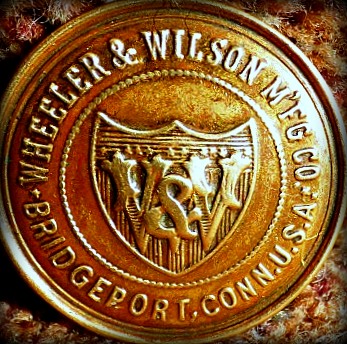
The No 9 continued in Singer clothes up until the outbreak of World War One. I have a Singer/ Wheeler in my Sewalot collection. It has all the Singer marking and decals but still the Wheeler & Wilson brass badge in the bed.


The perfect scene. A ladies parlour with a Wheeler & Wilson No 9 waiting for alterations.

And so ends Wheeler & Wilson story, once the largest sewing machine business in the world. Now little more than a small footnote in our history.

However at one time Nathaniel Wheeler and Allen B. Wilson were giants amongst the few.

The Wheeler & Wilson sewing machine No 8 circa 1880. This machine should have been a huge success but its industrial looks led to poor sales. It sewed like a dream and even today they are great sewing machines.

With over a million Wheeler & Wilson sewing machines made, every collector should have at least one model in their collection. I know a few collectors that have dozens. If you do come across an early model it may be silver plated or even have Mother of Pearl inlay.


The Wheeler & Wilson No 8

The model No 1 is my personal weakness. It was made for decades with only minor changes and is still one of the finest looking and best sewing machine for actually sewing on.


The Wheeler & Wilson No 9. All the advertising in the world and loads of awards could not save the company from Singer's takeover in 1905
 

The End


  Well that's it, I do hope you enjoyed my work. I spend countless hours, collecting, researching and writing these pages and I love to hear from people so drop me a line and let me know what you thought: alexsussex@aol.com

Fancy a funny read: Ena Wilf  & The One-Armed Machinist

A brilliant slice of 1940's life: Spies & Spitfires


Alex's stories are now available to keep. Click on the picture for more information.


 Skylark Country


 Home            Index                Books


Sewing Machine Fault Finder                     Sewing Machine Tension

CONTACT: alexsussex@aol.com  Copyright ©