Home of the Sewalot Site


By Alex I Askaroff


For antique and vintage sewing machines


Index

Home

Fault Finder

Machines for Sale

Valuations

Books

Our Collection

Reviews

Stories

Pictures

Links


Renovations

New Stories

Poetry

Crows Nest Publications


Willcox & Gibbs

A brief history

Willcox & Gibbs needles


  Alex I Askaroff

Alex has spent a lifetime in the sewing industry and is considered one of the foremost experts of pioneering machines and their inventors. He has written extensively for trade magazines, radio, television, books and publications world wide.

    
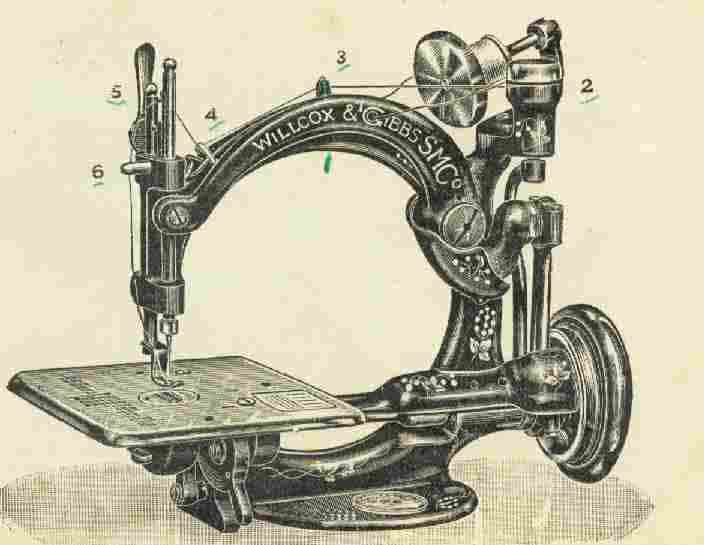
the classic W&G machine circa 1880


James Edward Allen Gibbs was a farmer from just outside Raphine in Rockbridge County, Virginia. He rarely saw the outside world. When he came across a picture of a Grover & Baker machine in a newspaper he decided to try and copy it. Mainly with a penknife a few farm tools and some wood. Keen or what!


James Edward Allen Gibb's wooden patent model

Because he had only seen the top half of the machine he had to imagine how the bottom would work. What he had not realised was that he had invented a completely new method of sewing, the chain stitch. In fact he did not even patent it for a while.

In 1856, Gibb spotted a Singer model A in a shop and examined it carefully. Realising that his idea was completely different to any other machine he knew he was on to a winner.

In metal his machine would be half the price half the size and half the threading. 

James Edward Allen Gibb was known by many as Allen Gibb. Allen patented the first chain-stitch single-thread sewing machine on June 2, 1857, after an earlier patent for part of a sewing machine in 1856. He was awarded patent number 17,427 on his machine. 

Though I have to say that on his machines there are at least five patent dates that pre-date this one. One as early as 1846! So was he working on the idea of a sewing machine for a lot longer than we think? Farming is busy one second and waiting the next, so we can guess that he spent his spare time fiddling with his invention then shelving it when busy. Oh for a time machine to help my research!

Anyway, Allen Gibb, in partnership with James and Charles Willcox, who were manufacturers of new fangled ideas, became a principal in the Wilcox & Gibbs Sewing Machine Company. Gibbs  apparently worked with Willcoxs' son, Charles, to build the first proper patent model.


J E A Gibb a very 1860's look!

He later recounted, "I was in Philadelphia in 1857 selling the first of my first two inventions in the office of Emery, Houghton and Company, when James Willcox came in. He remarked that he was a dealer in new inventions, and he asked me to come to his shop in a Masonic Hall and build a model of my machine for him".

The design of the W&G machines were based on the two main patents taken out by Gibbs in 1856 and 1857. The patents related to the formation of a chain stitch by a rotating hook and straight eye-pointed needle.

In 1858, Willcox & Gibbs engaged the firm of J. R. Brown and Sharpe of Providence, Rhode Island, to produce the sewing machines. The first ones were finished in November 1858. Willcox, who was in charge of production had little problem with Brown & Sharp because at the time were makers of clocks, watches and measuring instruments.

Among those who worked on Willcox and Gibbs machines at the Brown and Sharpe factory was one Henry Leland who was in charge of the sewing-machine department from 1878 until 1890. See a little note of interest I have added at the bottom.

And so in 1858, the company had finally began the manufacture of a chainstitch sewing machine which gained popularity at once. While Grover & Baker and Wheeler & Wilson sewing machines were selling for around $100, the Willcox & Gibbs machine sold for $50.

Don't forget the weekly wage was little more than a few dollars in 1858, two years before the American Civil War.

To market their machine, Willcox and Gibbs opened an office at 658 Broadway in New York City the following year.

The machines were a great success as they were half the price of competitors and generally regarded as the most reliable of any single thread or chainstitch machines. Gibb advertised his machines as having an elastic chain stitch and they certainly handled many different fabrics with ease. 


Early Machines have a wealth of patent info on them. This one is very unusual as having an 1846 date. In fact there are five pre-1857 dates!

Note how, if you look at the back of a W&G machine, the profile/outline of the machine is a perfect G, a clever little idea Gibb had so that you always recognized his machine. Between Charles & James Willcox, Allen Gibb made one of the most famous sewing machines in the world.   

One of the best things about the W&G machines is that all the components were checked with very accurate watch and clock gauges to ensure that all parts were easily interchangeable. This was truly mass production on a superb quality and scale. Their machines were much lighter and smoother than the competitions and were ideal for such difficult tasks as hat making. 

With sales flourishing, Willcox & Gibbs had their impressive main offices on Broadway in New York and established themselves as major players in the sewing field.

Due to the weight of shipping the machines to England, the firm had special hand wheels cast, originally in Coalbrookdale, England. Been there it's great.

These hand wheel versions were completely different to the large cast iron treadle ones that sold in the States and have proved a great favourite with collectors.   

Coalbrookdale

Coalbrookdale has been referred to as the one of the most extraordinary places in the world. It was where the industrial revolution all started in the 18th century. A steep valley with the fast flowing River Severn cutting through its middle it was the perfect place. It had all the mineral resources in abundance and pioneers like Abraham Darby and Thomas Telford concocted their magical potions. They made miracles come true and changed our world forever. If you ever have the chance to visit this beautiful place you  will be inspired. Early Coalbrookdale iron and steel is highly collectible today.

Willcox &Gibbs went on to advertise their superb machines in many ways.

If one thread will do, why bother with two,
To break, to confuse, and to tangle?
There is not a sound when my looper goes round,
No shuttles or bobbins to jangle.

I am quick, yet I make not a single mistake,
You have only to keep me a-going. 
And never will I shirk the least bit of work. 
But do all the family sewing. 

All have confessed, that I am best 
For fine robes for dear baby I prepare; 
While the boisterous boy will fail to destroy 
My work with the roughest of Wear. 

And when the fair maid is for bridal arrayed 
I make with the neatest of seams, 
The elegant trousseau, that gratifies you so, 
And fills the fond lover with sweat dreams. 

An article praising The W&G  machine appeared in an 1859 issue of Scientific American.

It concluded that-- one cannot but admire the beauty and accuracy of the machine's movements, and the entire absence of all noise, even when it is running at the rate of two-thousand stitches and upwards per minute. the machine was a hit and sold like hot cakes.

In Britain, orders we initially taken by a Miss Headdon of Fleet Street as can be seen from the advert below.


The company set up at 37 Moorgate Street 150 Cheapside and 135 Regent's Street, London, Willcox & Gibbs  later had their head offices in Fore Street, London, in the same road as Frister & Rossmann and several other major manufacturers and importers like The American Sewing Machine Co. They must have all known each other and been in competition with each other.

W&G protected their machines as well as possible and advertised strenuously to put people of from buying similar models.

For example it is well known that Frister & Rossmann bought out an almost identical chainstitch to the W&G. They in turn sold these models to The American Sewing Machine Co (A British firm funnily connected in some way with the importers E. Todd).  Also Meyers of Leipzig  and Clemens Muller had similar machines as well as several others like the National Sewing Machine Company in Fetter Lane, London.


A super rare W&G copy, Frister & Rossmann's Berlin Chainstitch now in my collection

Due to the superb engineering of these chainstitch machines they were popular for many decades and remained almost unchanged except for minor feed modifications since the introduction of the Automatic Tension in 1874.

The pre 1874 models had a glass tensioner models and are now extremely rare.


Standard threading, oiling and parts for the Willcox & Gibbs machine

The pre-1875 non-automatic tensioned W&G machines are similar but different.

Below is a picture from one in my collection. They rarely survive in this condition and it is worth looking at your normal machine and comparing the differences, there are many. 


An early 1872 model Glass tensioned Willcox & Gibbs machine. Some came on deeper wooden bases.

In 1887 a Willcox & Gibbs Automatic machine was selling in the UK for £6 with its box and bits. Now, with the average wage at under ten shillings a week this represented a sum of 12 weeks wages! What would that be today. Average wage £300 a week times that by 12. Now you see why they are such good buys on Ebay. Grab one while you can before they rocket again!

You can understand why these beauties have survived, they were built with no expense spared and were little masterpieces of Victorian engineering. Today technology has marched on but you will never beat this model for sheer quality.


James Gibb did not only make the usual models this is from an 1877 patent application.


And now for my final little fact:

Leland, one of the men at the Brown and Sharpe factory went on to devote the skills that he had learned on sewing machines to good use, forming the prestigious Cadillac Car Company. How about that for a cracker! 

The End

like that? I spend hours researching and writing so do let me know: alexsussex@aol.com


Fancy a funny read: Ena Wilf  & The One-Armed Machinist

A brilliant slice of 1940's life: Spies & Spitfires


Alex's stories are now available to keep. Click on the picture for more information.

Time for a great true story: Patches of heaven

Main Site Index: Index

Need any extra info just mail me: alexsussex@aol.com


This website is Copyright © 2000 & 2008  SSM

CONTACT: alexsussex@aol.com

Home            Index                Books