|
|||||
|
|
Alex has spent a lifetime in the sewing industry and is considered one of the foremost experts of pioneering machines and their inventors. He has written extensively for trade magazines, radio, television, books and publications world wide.
Most of us know the name Singer but few are aware of
his amazing life story, his rags to riches journey from a little runaway
to one of the richest men of his age. The story of Isaac Merritt Singer
will blow your mind, his wives and lovers his castles and palaces all
built on the back of one of the greatest inventions of the 19th century.
For the first time the most complete story of a forgotten giant is
brought to you by Alex Askaroff. See Alex Askaroff on Youtube http://www.youtube.com/watch?v=8-NVWFkm0sA&list=UL
|
||||
|
The Singer 66 & 99
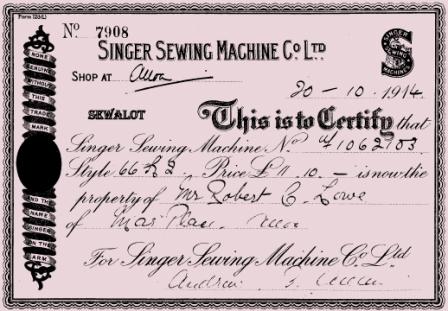
The 20th century sewing machine The Singer 66 was the first mass produced sewing machine, in my opinion, that produced a near perfect stitch. When sewing well the 66 will out-sew nearly any modern machine through a huge variety of fabrics from linen to lace, horse blankets to buckram. It is simply near perfect engineering but this came at a price. A Singer 66 was one of the most expensive sewing machines on the market costing several months wages. Now let me explain, in 1916 a basic Singer 66k was £7,10s. Doesn't sound much until you find that many people were earning less that a pound a week. Suddenly the machine cost nearly two months wages, in today's terms, a fortune. Most sewers would opt for the Singer 17 or 27 or another make or even its smaller twin, the Singer 99 at £6.10, but for those professional sewers who wanted more foot clearance and space the Singer 66 was the queen. Expensive but simply the best on the market at the time.
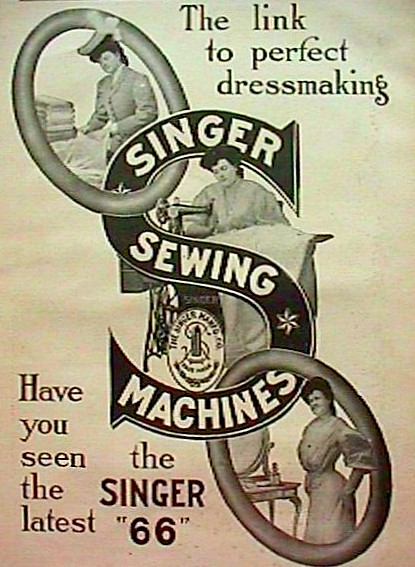
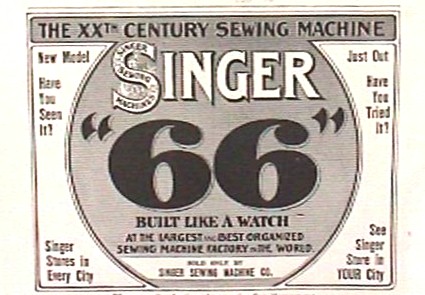
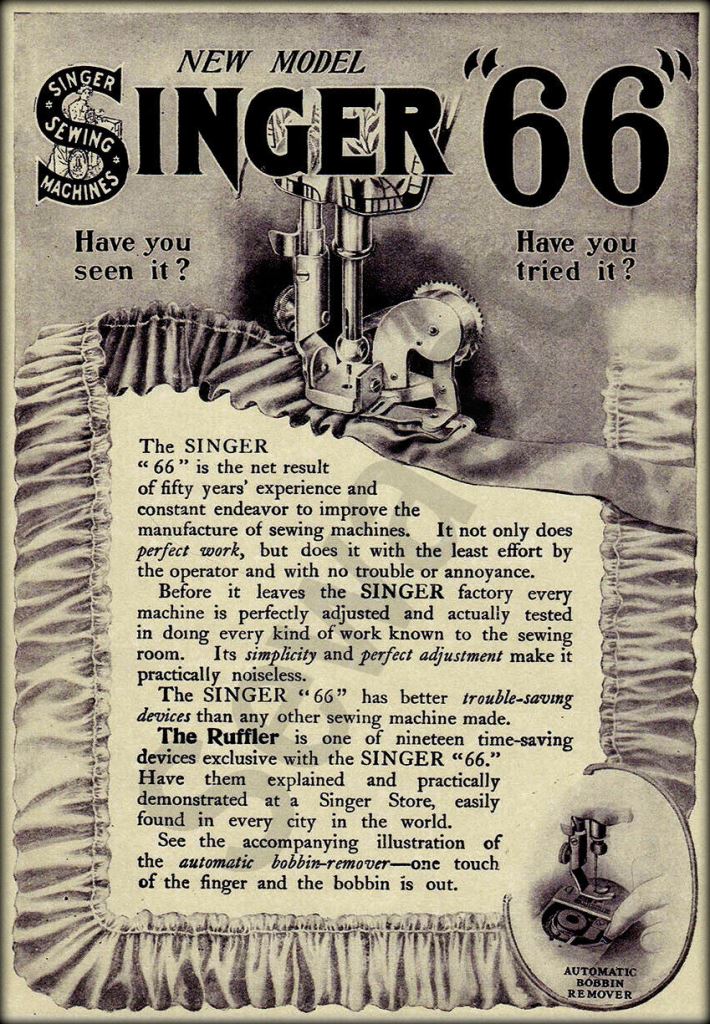
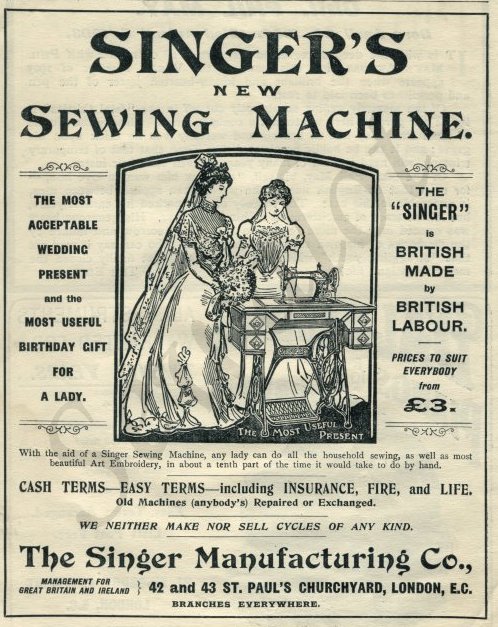
Built like a watch in the largest sewing machine factory in the world The 66 arrived after nearly half a century of improvements and developments. The mass produced machine was introduced to the world after it first came off the production line in America in late October of 1902. After its success abroad the factory at Kilbowie, Scotland, was re-tooled and in 1907 the first all British Singer model 66 sewing machines hit the market. The 66 used the smooth oscillating hook. The hook mounted horizontally allowed the bobbin to be simply dropped into the machine. The simplicity of threading and perfection of stitch made the 66 an instant best seller. The high-arm clearance and sewing ability was second to none. As the advert said, Built like a watch in the largest sewing factory in the world. For those who could not afford to buy the machine outright Singer had perfected their hire purchase system of part payments that they had introduced back in the 1850's. You could buy your machine in monthly instalments at a price to suit your pocket and pay for it from one year to 20 years.
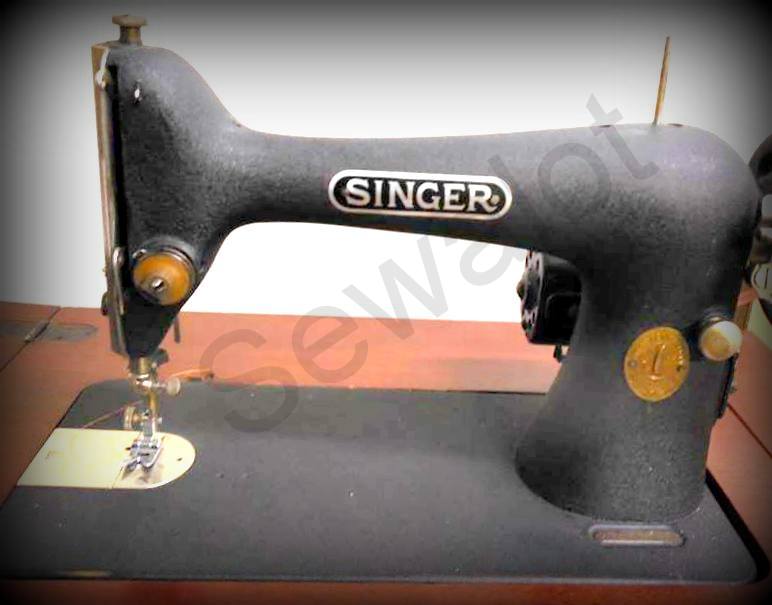
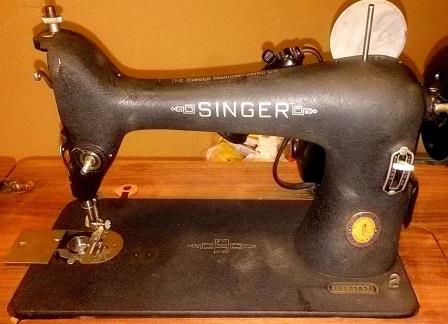
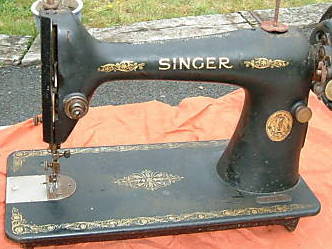
The Singer model 66 ran from the 1902 right up until the model was superseded by the amazing Singer 201, that was around 1956 in America and production ran from 1907 to 1940 in Britain. Production stopped earlier in Britain as Singers re-tooled in the late 1930's to help in the war effort making everything from machine gun bullets to hand grenades. After hostilities ceased the British factory sold of the last of the old stock model 66's but never restarted the assembly lines for that model. This is a 1940 model 66 in a rare Godzilla or crinkle finish sometimes attributed to war sales.
The later even smoother Singer 201came on line in the late 1920's but by 1950 it finally took the place of the Singer 66. The Singer 66 was a great machine but the Singer 201 was possibly the finest Singer straight stitch ever produced. Check out my blog on it. You can date your British Singer sewing machine from this list that I put together over the years. Dating British Singer sewing machines The smaller stable-mate to the Singer 66 was the Singer 99 identical except for size and a wonderful performer. Many women became so fond of their 99's they named them. I met one who was called Merlin as it sewed like magic. Then there was Pavarotti, so named because the owner only paid a tenner for it and another called Clackity Clara because it made so much noise.
The Singer 99 was identical to the Singer 66 in all but size and lasted longer in production, running right up to the middle 1950's with almost no major changes. A reverse was added after the Second World War around 1949. The Singer 99 was updated and morphed into the more modern 1950's style of the Singer 185k. Basically the same machine with a paint job. Then it disappeared as plastic multi-stitch machines took over.
Here is a little Youtube clip that I did on the Singer which is fun. Alex Askaroff on YouTube: https://www.youtube.com/watch?v=WOZhNf7eGMc Fitting the slide plate to a Singer sewing machine model 99 or 66
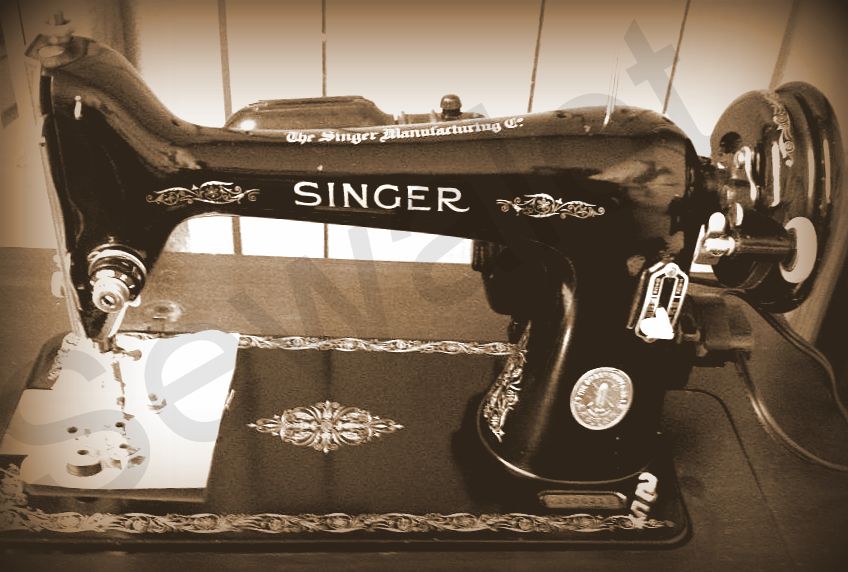
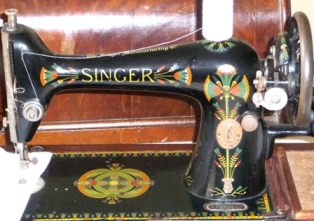
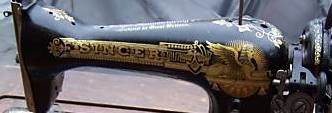
The British Singer 66's were adorned with three different decals. Firstly the Lotus petal as seen below. Then came the Sphinx which was also used on the Singer 15k and a few other shuttle models. In good condition both these look stunning. In America the Lotus patter was used for a while but the famous red-eye pattern stayed with the machine whereas in Britain the Singer 66 had three decal changes.
The Singer 66 was sold in all formats, hand, electric and treadle. In Britain the hand machine was the most popular until electric motors became more affordable in the 1930's. The bolt-on motor cost £5.17s, two weeks wages or more in 1933.
I met a woman once that bought a Singer in 1926 and did not finish paying for it until 1941. She had spent 15 years paying off her machine. Wow! I have a little of her story at the bottom of the page and it even includes a German bombing raid so it is great reading.
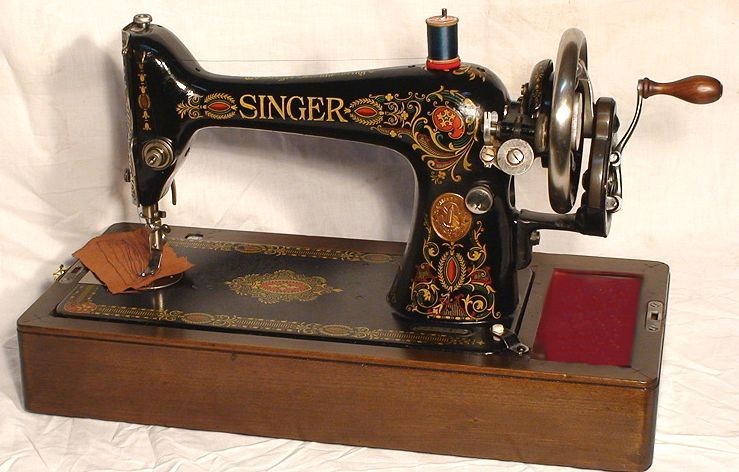
Now, in America the Singer 66 wore different clothes. This was to have a huge effect on its later values. In America the machine became fondly known as the Red-eye for obvious reasons. The machine does look like it has exotic eyes. The beautiful decoration made it sought after by enthusiasts and collectors.
In Britain the Kilbowie machines started off with superb decoration known as the Sphinx (above) and Lotus Petal but was soon replaced with a pretty but unimpressive basic gold decal as seen below.
By the outbreak of WWII the Singer 66 was no more in Britain and the superb stitching but mundane looking Singer 201 took over. It was a similar size to the 66 but with greater sewing ability at speed due to its modern revolving hook mechanism and worm-cut gears. It was smooth, almost silent and unbeatable. For the next two decades it dominated the professional market. The True Story Abridged. Annie Pratt, bought her Singer in the 1920's from the local Singer dealers in Plymouth. It was to make the christening gown for her first daughter and clothes over the years that followed. She treasured the machine and made many bits and pieces on her, always lovingly cleaning and oiling before putting her away. By 1941 the family were living in Alexandra Road in Plymouth. Plymouth is a big naval base on the South Coast of England. It is where Francis Drake and the British fleet sailed to attack the Spanish Armada in 1588 and where Admiral Nelson set sail to get rid of more pesky invaders in 1805. Anyway I digress.
In 1941 Britain was having a pretty bad time with German bombers
dropping bombs everywhere, once more trying to invade our little island
nation. The Blitz was not just on London where my English family were but covered many industrial
towns as well. Luckily she only had minor burns on her hands. She sewed on her machine, now called Lucky, for many more years before passing it on. Can you imagine today rushing into your burning home just to grab your sewing machine! That's dedication. Her full story is in my book, Have I Got A Story For You by Alex Askaroff
Most of us know the name Singer but few are aware of his amazing life story, his rags to riches journey from a little runaway to one of the richest men of his age. The story of Isaac Merritt Singer will blow your mind, his wives and lovers his castles and palaces all built on the back of one of the greatest inventions of the 19th century. For the first time the most complete story of a forgotten giant is brought to you by Alex Askaroff.
|
|||||
|
Fancy a FREE funny read: Ena Wilf & The One-Armed Machinist
Good morning Alex, Hello Alex, Mr. Askaroff Great site Alex, Well done mate. Mike, Aus
The Singer 15k in 1916 cost £15,10s. Exactly the same as the Singer 66. The machines were the Singer Companies top sewing machines. This beauty in the cabinet cost an extra £2, another two weeks wages! Drop me a line and let me know what you thought: alexsussex@aol.com
Sir Sewlot, protector of the Sewalot Site
Hi Alex,
Thank you soooo much for your pic of how to put in the bobbin cover on
my 99k. this machine saw little use in the 1956 era as my mother unlike
my Grandmother was not a seamstress. I had the machine serviced and was
agog to find the plate taped in place. As one would think it might be
the wrong part ordered a new one. I was aghast to find it also did not
SEEM to fit. I was about to return with a scathing email when I
consulted your web site. I had been used to using a Singer feather
weight which the cover slides to the left. The new part is very stiff
but I am sure with time I will manage. After your article I am now on
the hunt for a 66. It is neigh to impossible to get a lovely straight
stitch as I see on the old linens( especially German). I sew on vintage
fabric and wish to give the best possible look.
|
|||||
|
|
|
||||
|
CONTACT: alexsussex@aol.com Copyright © |
|||||