|
|||||||||||||||||||||
|
|
Alex has spent a lifetime in the sewing industry and is considered one of the foremost experts of pioneering machines and their inventors. He has written extensively for trade magazines, radio, television, books and publications world wide.
|
||||||||||||||||||||
|
Most of us know the name Singer but few are aware of his amazing life story, his rags to riches journey from a little runaway to one of the richest men of his age. The story of Isaac Merritt Singer will blow your mind, his wives and lovers his castles and palaces all built on the back of one of the greatest inventions of the 19th century. For the first time the most complete story of a forgotten giant is brought to you by Alex Askaroff.
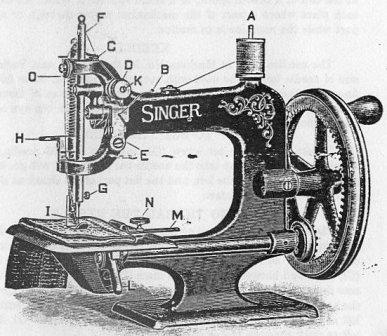
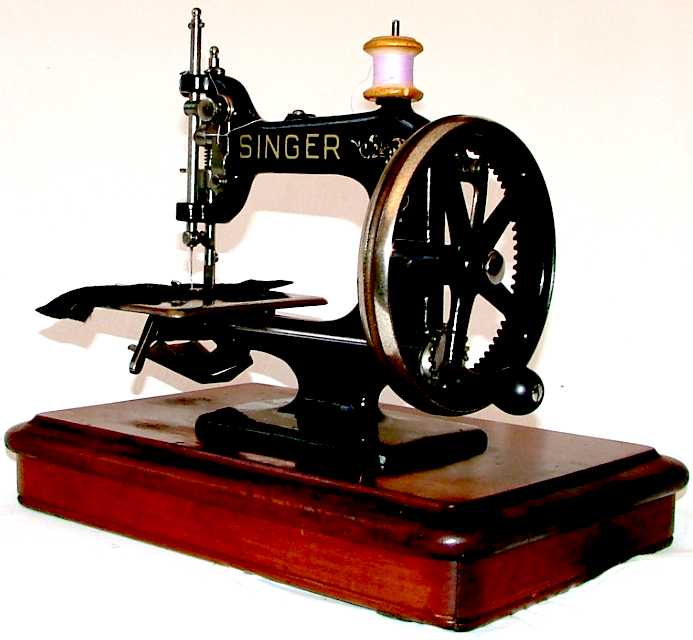
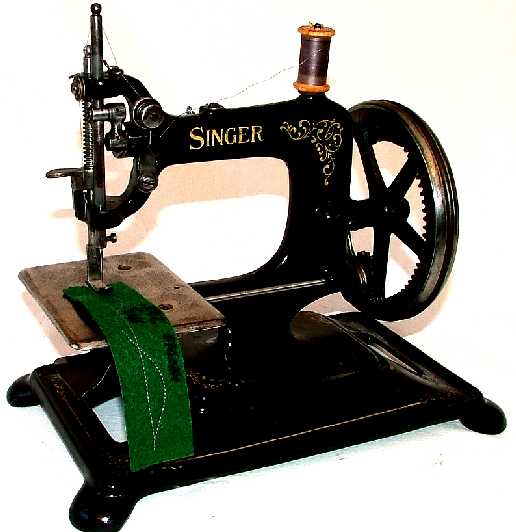
The Singer 30 Chainstitch sewing machine 1910-1914
Most singer sewing machines are well known but the Singer model 30 is one of the rare models in the Singer range where hardly any facts have come to light. I have put everything I have found out on this page but it has been a hard slog picking up crumbs of information over the last years.
I first heard about the Singer 30 model in March 2001. A friend asked if I knew anything about the model. Unusually he was an expert, growing up in the sewing trade like me, so when he knew nothing about the machine I knew it was something very special indeed. The search was on. This sparked my interest as I had never seen one of these rare little gems. It turned out that they had been made for a very short time just before the First World War. They were probably made to compete with the famous Willcox & Gibbs chain stitch machines. Besides this, I could find out very little information and no pictures of the machine came to light. I was intrigued. The quest was on.
Later at the ISMACS (International Sewing Machine Collectors Society) convention, in Winchester, there was a lovely machine on the sales table, looking sad, rusty and neglected, but what a beauty. I immediately fell for it and found out it was Graham who was selling it. It now made sense why he had asked about the model. After some fierce bidding among other collectors I came home with my first Singer 30.
Made only in Kilbowie for a very short period around the Great War the Singer 30 is a stunning piece of engineering. All these years later I have still only ever come across three Singer 30's and all were made in the year 1913. Also all had a serial number starting with F367****. One can guess that only a small production run were made and later investigation showed production figures of only 15,500 were ever produced between July 1912 and June 1913. They are so rare that until more information arises we may assume that they were only manufactured in that year, though recent information shows Singers had the Singer 30 in design as early as 1910. The main production year where 10,000 were produced was the first six months of 1913. It maybe obvious why the machine was made, to compete with the best selling chain-stitch of all time the Willcox & Gibbs. However we know that Singer made the super Model 24 chainstitch which sold to children and adults alike. All Singer model 30's are hand operated but have the extra grooved flywheel so that bench operation via a treadle was possible. I bet somewhere in the world is a Singer 30 on a treadle.
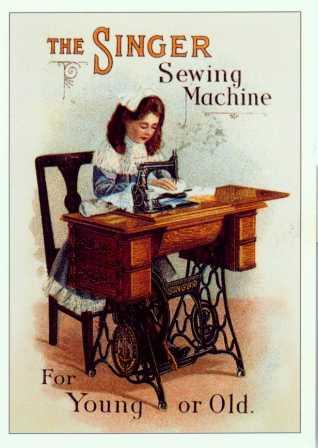
The 24, the 30's closest companion, is almost silent in operation and very smooth. The 24’s were mainly produced in Elizabeth, New Jersey, USA. The model 24 ran with few changes from late the late Victorian period right up to the 1950’s when even electric models were offered. Here we see a Singer 24 being advertised for children to use in the 1920's So now we go back to the question why did Singer produce the model 30? They had a perfectly good chainstitch already. We can guess that the Singer 30 made at Kilbowie on the banks of the river Clyde in Scotland could have been to temporarily fill a gap in production at the giant factory that had to keep upwards of 16,000 workers busy. Maybe a lull in production saw the opportunity to make a British Singer chain-stitch machine. What we do know is that it did not last long. In 1914 the Great War erupted and 20 million men went to their deaths. After the war the deadly pandemic, Spanish Flu, wiped out another 22 million. The Singer model 30 was simply forgotten, production ceased.
The Singer 30 just seemed to disappear. One day we may know why it ceased. However for a collector the Singer 30's are a dream. Beautifully made with superb craftsmanship the machine is a delight to sew with. Light and smooth it produces a simple chain-stitch perfect for costumes and hats. The large hand wheel is grooved to take a treadle belt so it could have been used on a bench if needed. The Singer 30 takes the same needle as the singer 24 and many of the Singer toys which is a 24x1 code. It is a short, stubby flat-sided needle and nothing but the original will work properly. The basic model was sold without the optional, base to be screwed or clamped to a table. However for an extra 15 shillings a cast-iron ornamental base could be added so that the machine was portable and did not need clamping to use. These are the rarest of the Model 30's.
The 1913 Singer 30 was quieter, cheaper and lighter than the Willcox & Gibbs and produced a near identical chain stitch. It was beautiful to look at and a dream to sew with. We can only assume that The start of the First World War and Singers switching to arms manufacture put paid to one of the finest sewing machine they ever produced. Values Even back in the 1990's a decent Singer 30 working and complete could fetch over $1,500. They are a collectors dream, so if you spot one don't let it get away. Chances are it will be a long time before another turns up.
If you have any information to
add I would love to hear from you: alexsussex@aol.com
Most of us know the name Singer but few are aware of
his amazing life story, his rags to riches journey from a little runaway
to one of the richest men of his age. The story of Isaac Merritt Singer
will blow your mind, his wives and lovers his castles and palaces all
built on the back of one of the greatest inventions of the 19th century.
For the first time the most complete story of a forgotten giant is
brought to you by Alex Askaroff.
|
|||||||||||||||||||||
|
Well that's it, I do hope you enjoyed my work.
I spend countless hours researching and writing these pages and I love to hear from
people so drop me a line and let me know what you thought:
alexsussex@aol.com
Fancy a funny read: Ena Wilf & The One-Armed Machinist A brilliant slice of 1940's life: Spies & Spitfires
|
|||||||||||||||||||||
|
|
|
||||||||||||||||||||
|
CONTACT: alexsussex@aol.com ©
|
|||||||||||||||||||||